Today's Artists Inspired by Rothko's Color Field Painting Style
Silence is so accurate.
Mark Rothko
As we seek out today's inheritors of Mark Rothko's iconic color field painting style, we can't only search for work that looks similar to his. We must also pursue work that's founded on similar ideas. It's one thing for contemporary color field artists to imitate Rothko's visual style. It's quite another for them to share, and successfully communicate, Rothko's intentions. But how do we know what Rothko's intentions were? Simple. He told us.
In 1971, the city of Houston, Texas, became the recipient of a unique work of art: the Rothko Chapel, a modernist, octagonal structure containing 14 of Rothko's large-scale paintings. In the entryway, sacred texts from several of the world's religions are made available to visitors. They may take a book into the space or not. Rothko considered the building and the art contained within it to be a single work. The chapel is his defining achievement. It clarifies Rothko's intention that his paintings not be seen as ends in themselves, but be seen as means through which viewers might access a larger experience through color.
In other words, Rothko wanted viewers to do more than admire the arrangement of colors: he wanted the encounter with those colors to open a space for feeling, contemplation, and a heightened awareness of their own inner experience. As he put it himself: "If you are only moved by color relationships, you are missing the point."
The ten artists below carry that intention forward. Five of them work with IdeelArt, and we know their practice from the studio up. Five work beyond our roster. None of them imitates Rothko. Each, in a different medium, treats color or light as a passage rather than a destination.
Five IdeelArt Artists Who Share Rothko's Intent
Paul Snell
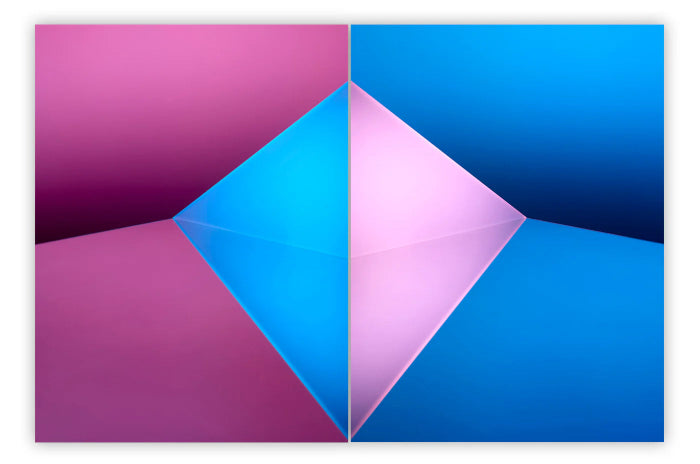
Australian artist Paul Snell, who lives and works in Launceston, Tasmania, begins with a photograph of a place or an object, then digitally strips it of everything recognizable until only bands of color, rhythm and light remain. The finished works are chromogenic prints on metallic paper, mounted on Plexiglass, and they glow like painted surfaces. Snell states his aim plainly: to immerse the viewer in color, rhythm and space, "creating a sensory experience of inner contemplation and transcendence." Of all the artists we work with, his words come closest to Rothko's own.

Anne Katrine Senstad
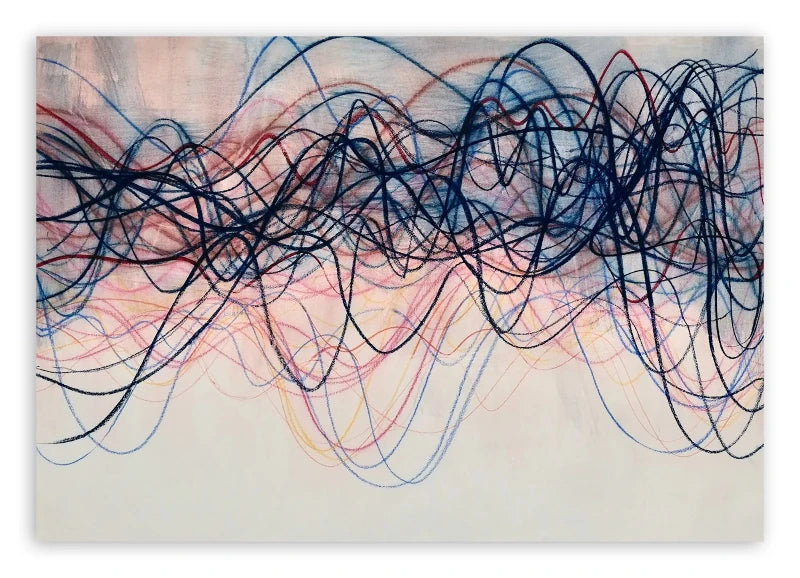
Norwegian artist Anne Katrine Senstad, based between New York and Oslo, works across photography, video, neon and immersive installation. Her series Color Kinesthesia, shown at Freight + Volume in New York in 2020, was conceived in dialogue with Rothko's color field paintings. The title refers to the body's response to transitions of color, which she captures by photographing color film negatives. Senstad describes her work as a perceptive and cognitive response to light, sound and color rather than a spiritual one. That distinction makes her a fascinating heir: she reaches Rothko's open, inner space through perception rather than belief. She has also exhibited alongside James Turrell, in the light art exhibition Through The Spectrum at Athr Gallery in Jeddah.
Senstad was also featured in the television series Immersive World, in an episode exploring light sculpture that presented her practice alongside those of Anthony McCall and Dan Flavin. This context extends the article’s central idea: color need not remain on a painted surface to become an immersive experience.
Discover Anne Katrine Senstad's work

Yari Ostovany
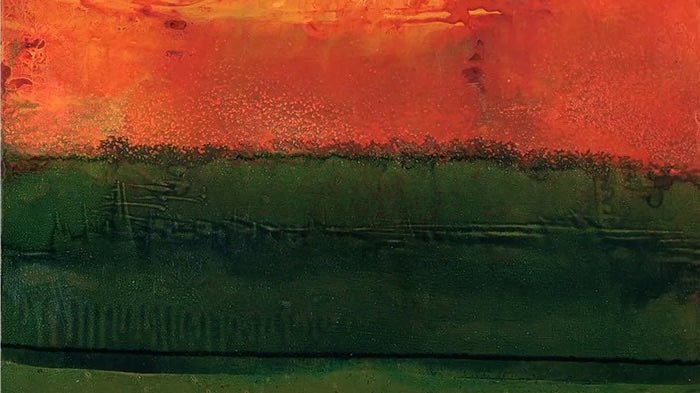
Iranian-born American painter Yari Ostovany, who lives and works in San Francisco, builds richly layered color fields through a long process of adding, washing out, scraping away and dissolving pigment. Each painting begins with what he calls a gestural outburst: calligraphic marks that he then rubs and dilutes until they merge with the layers beneath. His practice is rooted in Abstract Expressionism and Color Field painting, and in several mystical traditions of East and West. Titles such as Numinous, Missa in Angustiis (Mass for troubled times) or Conference of the Birds make the intention explicit. These are paintings meant to be entered, not merely looked at.

Arvid Boecker
German painter Arvid Boecker works in Heidelberg. He begins each painting with a penciled composition, then builds the surface in slow layers of color that he partially removes with screen-printing squeegees, leaving the traces of that erosion visible. He calls the result an "archaeology of color." Like Rothko's veiled rectangles, Boecker's strata reward slow looking. The longer one stays with a surface, the further the eye travels inward, through color and light, toward a quiet awareness of time passing. Read our conversation with him in Serious And Not-So-Serious: Arvid Boecker In 14 Questions.

Kim Uchiyama
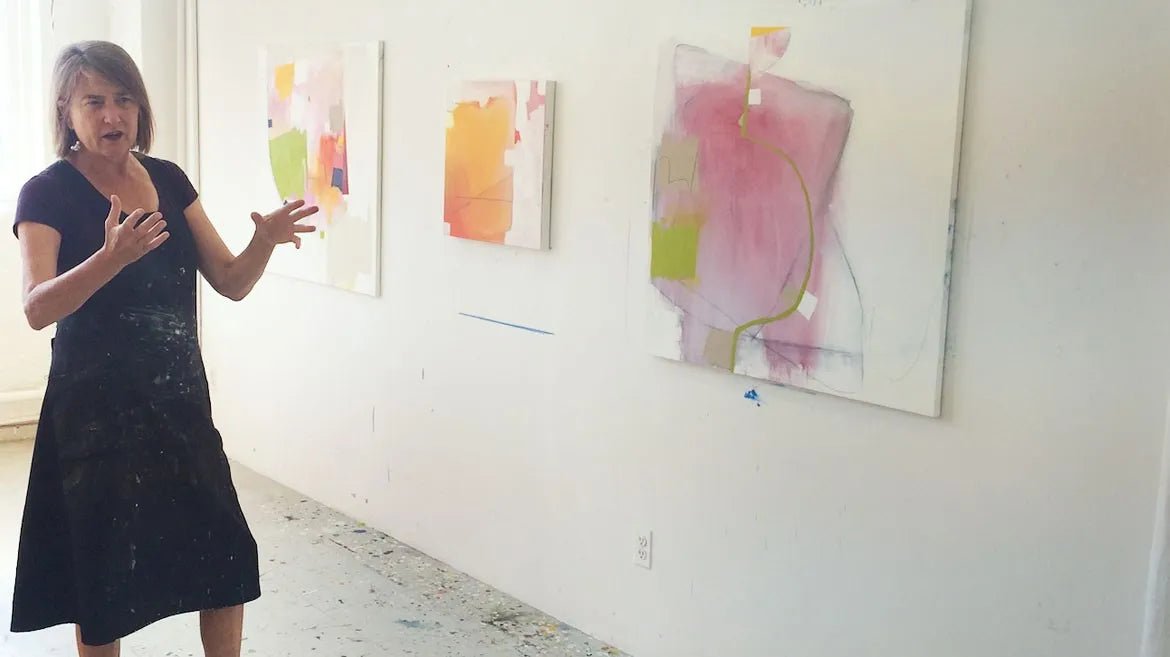
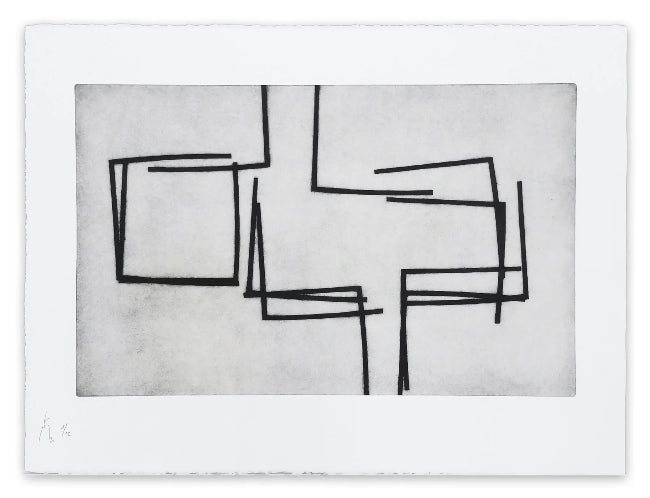
New York painter Kim Uchiyama uses color to build light and form, and to open the metaphysical potential of pictorial space. She studied with the painter Nicolas Carone, himself a student of Hans Hofmann, and shares their emphasis on color as the architecture of a painting. Before starting a work, she waits to "see" a first color on the blank surface, then builds a grid of color shapes, some opaque, some translucent. Often inspired by the light of a specific place, she uses color to convey its emotive essence rather than its appearance. That transfer, from what is seen to what is felt, is exactly the one Rothko sought.

Five Artists Beyond Our Roster
Sean Scully
Born in Dublin in 1945, Sean Scully is one of the most influential abstract painters working today, and the one most often compared to Rothko. The comparison is earned: in 1999, a year after beginning his Wall of Light series, he wrote an essay titled Rothko: Bodies of Light. Scully has described his task as reconnecting abstraction with the real world, so that people can get a direct feeling in front of an abstract painting. He also marks his difference: unlike Rothko, he has said, he is not passive. His stacked bricks of color are built, weighted and physical. In 2026, his exhibition To Feel opened at Thaddaeus Ropac in Salzburg, and his complete Stack series went on view at Château La Coste in Provence.

Sean Scully - Wall of Light Peru - 2000 - Permanent collection of the North Carolina Museum of Art
James Turrell
James Turrell, born in Los Angeles in 1943, has spent six decades working with light itself. His Skyspaces, chambers open to the sky through an aperture in the ceiling, and his immersive light rooms turn color into something you stand inside. His central statement reads like a gloss on Rothko: "My work is about your seeing." Raised in a Quaker family, he attended silent meetings where worshippers sat together waiting for inner light. In June 2026, his largest Skyspace in a museum, As Seen Below, opened at ARoS Aarhus Art Museum in Denmark. It is his 100th Skyspace.
 James Turell - Skeet - 1989 - Fondation Cartier pour l'Art Contemporain
Mary Corse
Mary Corse, born in Berkeley in 1945, is one of the few women central to California's Light and Space movement. In 1968 she discovered glass microspheres, the beads used in road markings, and began mixing them into her paint. Her White Light paintings shift as the viewer moves, because the light is in the painting rather than depicted on it. "The art is not on the wall, it's in the viewer's perception," she has said. Like Rothko, she locates the work in the encounter. Her first museum survey opened at the Whitney Museum of American Art in 2018 and traveled to LACMA in 2019.

Mary Corse at Pace Gallery - 2025
Olafur Eliasson
Born in Copenhagen in 1967 and raised between Denmark and Iceland, Olafur Eliasson works from a large studio in Berlin. His rooms of colored light, fog and reflection are built around an idea he calls "seeing yourself sensing": having an experience while being aware that you are having it. Eliasson acknowledges that the phrase owes much to the Light and Space artist Robert Irwin, who spoke of perceiving yourself perceiving. Rothko asked viewers for a heightened awareness of their own inner experience; Eliasson made that awareness his subject. He often places the word "your" in his titles, as a gesture of trust towards his audience.

Olafur Eliasson - From the exhibition Reality Machines at Tanya Bonakdar Gallery - 2016
Rachel Garrard
British artist Rachel Garrard, born in Devon in 1984 and living between New York and Mexico, grinds her own pigments from rocks and minerals collected on her travels, including crystal quartz and ash. She describes her practice as a journey between scientific research and esoteric practice, and her compositions are informed by meditation. Her paintings carry no image and no fixed meaning. They aim at an experience beyond language, a link between the outer world and the inner one. In her generation, she is among the artists closest to Rothko's conviction that a painting is a threshold rather than an object.

Rachel Garrard - Inflect, 2015
Beyond the Surface
Rothko's late paintings ask for time and silence. So do these ten bodies of work, whether made with oil, watercolor, rock pigment, film negatives, glass beads or the sky itself. What connects them is not a rectangle or a palette but a shared conviction: that color, given enough attention, can return us to ourselves.
Explore more contemplative abstraction in our minimal artworks, or read our Ultimate Guide to Mark Rothko.
Francis Berthomier
Featured image: Yari Ostovany - The Third Script 45, 2023 (Detail)All images used for illustrative purposes only