
Famous Abstract Paintings That Changed The Way We Perceive Art
“What images we can have, one might say, depends on who is doing the imagining.” - John Hospers, from An Introduction to Philosophical Analysis
We depend on visionaries to open up hidden doors, so we might glimpse parts of the world, and parts of ourselves, that may otherwise remain hidden. Vision is the specialty of abstract artists, and over the past 100+ years, many famous abstract paintings have succeeded in enlarging humanity’s view. The visionaries who created those images not only endowed us, the viewers, with the gift of new things to see; they offered us entirely new ways of seeing.
These breakthroughs are not confined to art history. Alongside each historical artist discussed below, we look at a work available through IdeelArt that approaches related questions of line, geometry, material or colour. These pairings are invitations to look, not claims of direct influence: each artist gives these shared questions a language of their own.
Famous Abstract Paintings: 1910s – 1920s
Admittedly, some of our selections in this article may prove controversial, since every abstract art lover has different tastes. But most would probably agree with our first selection of abstract paintings that changed the way we perceive art. Wassily Kandinsky’s Untitled (First Abstract Watercolor) was painted in 1910 and is considered by art historians to be the first purely abstract painting. The bold portrayal of vibrantly colored spots, smears and lines foregoes all visual reference to objective reality. This painting freed artists from the bondage of subject matter and invited viewers to engage in an entirely new way with the concept of what an image can be.

Wassily Kandinsky - Untitled (First Abstract Watercolor) - 1910
Centre Georges Pompidou, Paris
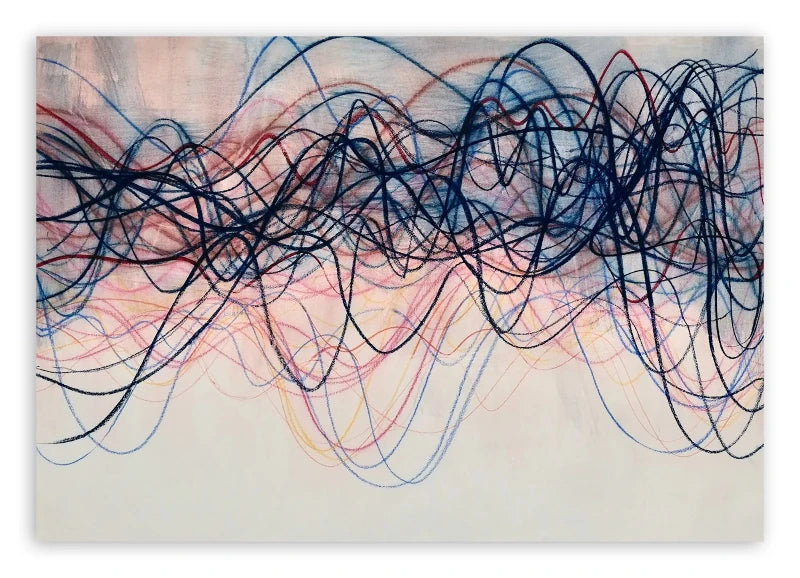
What happens when line and colour no longer have to describe an object? In The Eye, Macha Poynder offers a contemporary response: looping marks, sudden flashes of yellow and pink, and layered passages of blue create a restless visual rhythm. Her practice combines automatic drawing, performative gestures and intuitive colour choices. Viewed beside Kandinsky’s watercolor, the painting suggests how abstraction can turn looking into an active experience, with the eye following relationships rather than identifying a subject.

Eleven years later in 1921, Piet Mondrian painted his iconic Tableau I. After a period of time experimenting with his emerging new voice, Tableau I solidified what would become Mondrian’s defining style. The hard black lines and compartmentalized color fields offered viewers a glimpse of purified geometry and mathematical precision. The clean lines and precision of the work made no reference to anything other than form, color and line. The work ushered in a style that would influence generations of painters, sculptors, architects and designers, and continues to guide creative thinkers today.

Piet Mondrian - Tableau I - 1921
Museum Ludwig, Cologne, Germany
Mondrian’s geometry also invites a question that remains open today: how little does an image need in order to change the way we see? Daniel Göttin’s Untitled 1, 2016 takes a different route through that territory. Black and grey vertical fields, separated by white lines, establish a regular pattern whose contrasts shift across the surface. Rather than repeating Mondrian’s signature palette, Göttin explores proportion, repetition, symmetry and asymmetry. The connection lies in the viewer’s experience of relationships: a line is not merely a boundary, but something that alters the space around it.

In 1925, Joan Miró dissolved the barriers between Abstraction and Surrealism with his painting La mancha roja (The red spot). Miró did not consider himself to be an abstractionist. He said that he came home to his tiny home, hungry and exhausted, and painted the images he saw in his head. La mancha roja (The red spot) straddles the thin line between anthropomorphic figuration, dreamlike totems and pure abstraction. Something childlike, yet horrible, lurks within the image. With this body of work, Miró flung open the door to the hidden iconography of our nightmares and dreams.

Joan Miro - La mancha roja (The red spot) - 1925
Museo Nacional Centro de Arte Reina Sofía Collection.
© Joan Miro Foundation, Barcelona
Miró’s forms hover between signs, imagined creatures and independent shapes. A related ambiguity animates Daniela Marin’s Medusae I, where striped, spotted and branching forms share a white field with open geometric structures. They suggest living things without resolving into a single identifiable scene. Marin’s vocabulary brings organic forms into dialogue with urban geometry, drawing on her own experiences and journeys. Her bright, expansive composition differs from the unsettling atmosphere described in Miró’s painting, yet both invite the viewer to move between recognition and invention: a shape can seem alive without becoming an illustration.

Famous Abstract Paintings: 1930s – 1940s
As the Western world descended into depression, famine and war for the second time in the 20th Century, abstraction was firmly established as a major force in the art world. A fantastic range of methods were being employed by artists working in the style, each contributing to the growing efforts to connect with something pure, something true and something free within the human spirit. In Great Britain, the painter Ben Nicholson expanded his abstract work into a body of what he called white relief paintings. Among these works is White Relief, Quai d’Auteuil (1935), an example of the approach that established Nicholson as one of the most important voices of English Abstraction. Nicholson was a friend of, and influenced by, the painter Piet Mondrian. The white relief works expanded on Mondrian’s use of hard-edged lines and geometric space, introducing dimensional layering and a monochromatic palette. Nicholson’s first white relief paintings were created in 1933, and by 1935 he had solidified a style that combined elements of abstraction, constructivism, concrete art, and which suggests the early seeds of Minimalism and Post-Painterly Abstraction.

Ben Nicholson - White Relief, Quai d’Auteuil - 1935
The Hepworth Wakefield Museum
Nicholson’s reliefs make space itself an active part of abstraction, through the relationships between planes, edges and depth. British painter Jeremy Annear offers a compelling dialogue with that concern in Construct (Red Disc and Triangle). Layered white, grey and earth-coloured shapes turn around curved contours, while a red disc and triangle punctuate the composition. Annear builds his oil paintings through layered forms and textured surfaces; here, their overlaps suggest a space that is constructed rather than described. Unlike Nicholson’s white reliefs, this is a coloured painting, but the shared question is how a limited vocabulary of shapes can establish balance, tension and a sense of depth.

On the other end of the spectrum during the 1930s and 1940s were the Abstract Expressionists, also known as the New York School. Thoroughly rejecting the rational geography and spatial reduction of artists like Mondrian and Nicholson, the Ab Ex-ers sought to connect with primal emotion in their work. No Abstract Expressionist was as influential and successful at embodying the style than Jackson Pollock.
A notorious alcoholic and neurotic, Pollock was inspired by psychoanalyses to reach deep within his subconscious for inspiration. His work drew on physicality and unconscious totem images to create fierce portrayals of modern, post-war anxiety. One of Pollock’s first drip paintings, Full Fathom Five, painted in 1947, forever changed abstract art. This work is an amalgam of his earlier brush style and his visionary drip technique. It includes coins, cigarette butts and other random bits from his studio, projecting a level of texture and depth entirely new to Abstraction. Full Fathom Five ushered in a turning point in Pollock’s career, and forever changed our relationship to the canvas.

Jackson Pollock - Full Fathom Five - 1947
© 2019 Pollock-Krasner Foundation / Artists Rights Society
The objects embedded in Full Fathom Five remind us that a painting can be more than a picture: it can be a physical accumulation of actions and materials. Anthony Frost explores that possibility through an instinctive process combining painting and collage. In Surface Pressure, rough-textured blue and orange areas are crossed by a projecting red strip, making the surface itself part of the encounter. Frost’s use of found materials and layered construction differs sharply from Pollock’s tangled drips, but both works invite us to look at painting as something made through physical engagement, not simply an image planned in advance.

Famous Abstract Paintings: 1950s
By the 1950s, the Abstract Expressionists had firmly taken over the imagination of the art world. Everywhere, artists were striving to connect with the primeval self, the unconscious mind, and the hidden imagery of the subconscious. In the midst of this fervor emerged a trend toward calmness, born partially from a growing interest among many artists in Eastern philosophies like Taoism and Zen Buddhism. One of the most profound movements to grow out of this time was an Abstract painting style known as Color Field Painting.
The objective of Color Field Painting, as it has come to be generally understood, was to explore color independently from subject matter, form, line, and the other constraints of image-making. A meditative quality was sought by the painters, and if successful was subsequently transferred from the work to its viewers.
The abstract painter Helen Frankenthaler was one of the most profound voices of the Color Field movement. With her painting Mountains and Sea, painted in 1952, Frankenthaler introduced the world to a new technique of painting she had invented called the “soak-stain process.” In this process, Frankenthaler used turpentine to thin the consistency of her paints. She delicately poured the thinned paint onto an unprimed canvas on the floor, allowing the paint to completely soak through the canvas, giving the work an entirely new texture and appearance. The soak-stain process created sublime fields of color that took on organic, morphing configurations touching on the serene. Frankenthaler’s Mountains and Sea is considered to have been one of the first successes of the Color Field movement and remains one of its most endearing images today.

Helen Frankenthaler - Mountains and Sea - 1952
© 2019 Helen Frankenthaler Foundation / Artists Rights Society
Frankenthaler’s painting opens a space between remembered landscape and independent fields of colour. Greet Helsen approaches that space through her own encounters with nature, working from impressions of light, shape and colour rather than precise descriptions. In Dynamisch (Dynamic), translucent pinks, blues and lilacs move across an airy surface, interrupted by fine dark lines and deeper pools of colour. Helsen carefully dilutes her acrylic paint so that successive layers remain visible. This is not the same process as Frankenthaler’s soak-staining, but the pairing lets us see how transparency and fluid colour can suggest a landscape without depicting one.

Perhaps the most famous artist to be associated with the Color Field artists is Mark Rothko, an artist who also vehemently rejected that, and most other labels. Rothko worked entirely with color, striving to open up a spiritual plane on which he and the viewers could experience the depth of human emotion. Though fully focused on color, Rothko dismissed it as only a vehicle through which this spiritual connection might be made. One of Rothko’s defining early works was No. 2, Green, Red and Blue, painted in 1953. This piece is iconic of Rothko’s future body of work, establishing his voice as a uniquely endearing inhabitant of both the worlds of Abstract art and transcendent spirituality.

Mark Rothko - No. 2, Green, Red and Blue - 1953
Can colour carry a feeling without describing its cause? That question connects Rothko’s work with Kyong Lee’s Emotional Color Field 6, although their visual languages remain distinct. Lee arranges horizontal bands that move from deep blue and violet through pink and pale tones to orange and red. Her process uses carefully measured fields and gradual colour transitions to explore changes in emotional state. Where Rothko’s soft-edged forms seem to hover, Lee’s divisions are clear and ordered. The dialogue is less about resemblance than about how one colour changes our experience of the next, and how those relationships can become an emotional language.

Famous Abstract Paintings: 1960s – 1970s
As Abstraction entered into the 1960s and 1970s, many painters were already rejecting its fundamental ideas, returning to figuration and exploring the realm of conceptual art. Nonetheless, the power of Abstraction’s clarity and freedom still held great promise. One of the most sublime voices of this period was the American Abstract painter Agnes Martin. Known for her lined grid paintings, Martin endures as an iconic voice of Abstract Art.
Agnes Martin’s painting Night Sea, made in 1963, is one of the earliest examples of what would become her definitive style. In the work, a nearly monochromatic blue background is intersected with a meticulous grid pattern painted in gold leaf. This work embraces color, while placing equal power on line. It embraces simplicity while simultaneously communicating vastness, complexity and a sense of interwoven interdependence. Martin spoke of how the line, to her, represented innocence. She hoped that the feeling of innocence was transferred to viewers through her work. The simplicity of her images, and the directness of the emotion she hoped to communicate, was instrumental in bridging the gap between Abstract Expressionism and Minimalism.

Agnes Martin - Night Sea - 1963
© Estate of Agnes Martin / Artists Rights Society
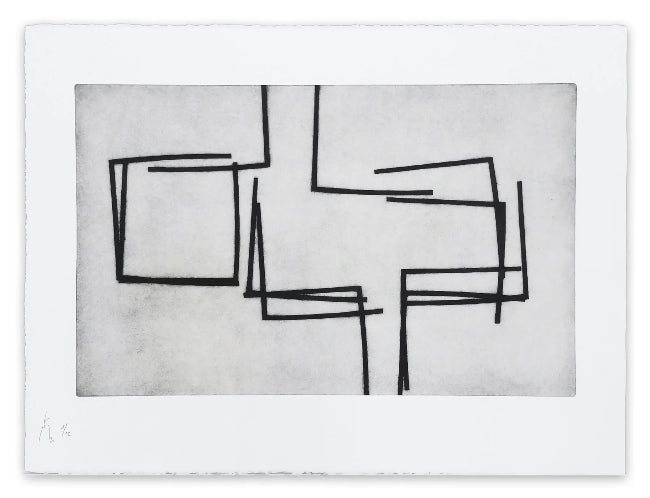
Martin’s restrained vocabulary shows how a line can hold our attention without describing anything. Richard Caldicott’s Untitled, 2014 (Id.383) offers a different, spare encounter with line and space. Against a pale ground, fine and heavier dark lines create an open angular structure between areas of red and yellow. Rather than repeating Martin’s grid, Caldicott reduces the composition to a few relationships whose balance becomes more apparent as we look. His serial works on paper explore a minimal, architectural language. The pairing invites a slower kind of attention: not a search for a subject, but an awareness of how intervals, edges and empty space shape our experience.

In the 1970s, Robert Motherwell shook up the world of Abstraction once again with a voice that seemed like the antithesis of Minimalism’s lure. His primal, rugged gestures conveyed energy, strength and anxiety all at once. There was a stoic strength to them and yet profound emotion came forth that embodied the power and freedom of pure Abstraction.
Motherwell’s defining work came in 1971, and was called Elegy to the Spanish Republic No. 110. This painting’s furious energy envelops the viewer and seems to burst off the canvas. There is a shocking vitality to it, aggression that transfers emotion and fury into space. At a time when many painters considered Abstraction to have played itself out, Motherwell injected a powerful new life force into the style. His fresh vision and confident voice helped Abstraction endure, and continues to inspire and empower Abstract artists to this day.

Robert Motherwell - Elegy to the Spanish Republic No. 110 - 1971
© Dedalus Foundation/Artists Rights Society
Motherwell’s Elegy demonstrates how repeated, forceful forms can give an abstract painting emotional weight. Tommaso Fattovich’s Punk approaches that weight through a more fractured, multicoloured language. Upright passages of black, pink, pale green and orange rise through a rough grey-brown ground, their edges carrying the traces of successive gestures. Fattovich develops his compositions intuitively, responding to colour, layers, lines and shapes until the image feels complete. The comparison concerns the physical presence of the mark, not an equivalence of subject: Fattovich’s urban-inspired abstraction does not share the specific historical meaning of Motherwell’s Elegy, but it offers another way to encounter gesture as a carrier of intensity.

Changing Our Perception of the Future
Today’s contemporary Abstract artists owe a debt to each of these artists, both for the ways they sought freedom in their modes of expression and for the ways they helped viewers open their minds to new ways of seeing. Abstraction continues to open new doors to us as we try to comprehend the endless complexities our evolving society presents us with. By drawing on the examples of the great Abstract artists of the past, the Abstract artists of today and tomorrow can hopefully help us translate our contemporary anxieties and fears, and help us to see beyond the limitations of our own eyes.
The works brought into dialogue with these historical paintings show that those possibilities remain open. From Poynder’s restless lines and Marin’s imagined organic forms to the constructed spaces of Göttin and Annear, abstraction offers many ways of engaging the eye. Frost’s material surfaces, Helsen’s translucent colour, Lee’s emotional sequences, Caldicott’s spare structures and Fattovich’s forceful marks extend the conversation in different directions. They do not replace the historical works or repeat their achievements. Instead, they invite us to carry what we have learned into new encounters, and to discover how abstraction continues to change the way we look.
Featured image: Wassily Kandinsky - Composition VII, 1913. © Wassily Kandinsky / Artists Rights Society / ADAGP
All images used for illustrative purposes only
By Phillip Barcio (2016) Edited by Francis Berthomier (2026)