
文章: Op Art: The Perceptual Ambush and the Art That Refuses to Stand Still

Op Art: The Perceptual Ambush and the Art That Refuses to Stand Still
To stand before a major Op Art canvas in the mid-1960s was not merely to look at a picture. It was to experience vision as an active, unstable, bodily process.
When the Museum of Modern Art opened The Responsive Eye in New York in 1965, the exhibition brought optical abstraction into the public spotlight with extraordinary force. Visitors encountered paintings made of vibrating lines, pulsing contrasts, unstable grids, and chromatic tensions that seemed to shift before their eyes. Works by artists such as Bridget Riley, Victor Vasarely, Richard Anuszkiewicz, Jesús Rafael Soto, and others challenged the idea that a painting was a fixed image awaiting quiet contemplation. The press soon gave this visual intensity a name: Op Art.

The Responsive Eye , MOMA, 1965 - Installation shot - ©MOMA
Too often, the legacy of Op Art has been reduced to 1960s nostalgia: psychedelic patterns, retro textiles, optical tricks, or decorative design. This essay argues the opposite. Op Art was never simply about dazzling the eye. It emerged from a serious investigation into perception, biology, movement, mathematics, and the unstable relationship between image and viewer.
In the sections below, we will explore the scientific and historical roots of Op Art, its radical rethinking of the spectator’s role, and its continuing relevance for contemporary artists working with geometry, color, photography, digital systems, and perceptual abstraction. For readers looking for a more direct factual guide, a detailed FAQ follows at the bottom of the page.
Born from War and Biology
To view Op Art merely as a vintage aesthetic is to miss its deeper conceptual weight. The movement did not emerge from a simple desire to make beautiful patterns. It was rooted in a much longer history of optical science, experimental psychology, and visual instability.
As early as the 19th century, scientists such as Jan Evangelista Purkyně helped demonstrate that human vision is not a passive recording device. The eye is not a camera. It is a biological organ constantly adjusting, compensating, seeking contrast, balance, and equilibrium. Color afterimages, retinal fatigue, simultaneous contrast, and peripheral instability all revealed that seeing is not merely a matter of receiving information. It is a process of active construction.

“Dazzled” PT Boat - Bayonne, NJ - September 28, 1942
One of the most striking historical precedents for Op Art appeared far from the museum: on the seas during the First World War. In 1917, British marine artist Norman Wilkinson developed what became known as Dazzle camouflage. Unlike traditional camouflage, which attempts to hide an object by blending it into its surroundings, Dazzle did the opposite. Allied warships were painted with fractured, high-contrast geometric patterns designed to make it harder for enemy submarine commanders to judge their speed, direction, distance, and angle of travel.
The effectiveness of Dazzle camouflage remains historically debated, and later analysis has complicated the story. But its conceptual importance is undeniable. It demonstrated that geometry could be used not only to decorate a surface, but to interfere with perception itself. The eye could be guided, confused, delayed, or destabilized by pattern.
Op artists would later translate this principle into the gallery. Their aim was not military deception, but perceptual revelation. They showed that a static image could generate movement, vibration, tension, and instability inside the viewer’s own visual system.
The Spectator as the Engine
Here is what separates Op Art from many other forms of geometric abstraction: the painting is intrinsically incomplete as long as it hangs in an empty room.
Op Art depends on the viewer. Its effects arise through looking, movement, distance, bodily position, and duration. A painting may be physically still, but the act of seeing it is not. The work comes alive in the encounter between image and eye.
This idea was pushed especially far by the European and South American avant-gardes working in Paris in the late 1950s and early 1960s. In 1960, artists including Julio Le Parc, François Morellet, Francisco Sobrino, Horacio Garcia Rossi, Joël Stein, and Yvaral founded the Groupe de Recherche d’Art Visuel, better known as GRAV.

Translated reproduction of the "Assez de Mystifications" Manifesto - 1961
GRAV’s position was radical. In texts such as the 1961 tract Assez de mystifications, the group attacked the mystification of art, the cult of the individual genius, and the idea of the artwork as a sacred, untouchable object. They wanted to replace passive admiration with active visual experience. Art, for them, was not a precious relic to be revered from a distance. It was a situation, a field of experiment, a direct encounter between the viewer and visual phenomena.
By using optical vibration, serial structures, moiré effects, light, movement, and immersive environments, GRAV and related artists forced the spectator to become a participant. The artwork no longer resided only in the object. It emerged through the viewer’s perception.
Simply by moving through the room, the visitor could activate the illusion. Foreground and background might invert. Lines could appear to bend. Planes could seem to advance or retreat. Color could vibrate. The work was not completed by the artist alone. It was completed by the biology of the beholder.
The Algorithmic Screen and the Human Retina
In the contemporary world, Op Art faces a new visual landscape.
We now live among billions of smooth, frictionless images: backlit screens, algorithmic feeds, AI-generated pictures, digital filters, and endlessly refreshed visual surfaces. Our daily experience of images is often fast, passive, and forgettable. We scroll, consume, and move on.
This context makes the physical force of Op Art feel newly relevant. A strong Op Art work resists instant consumption. It cannot be fully understood in a thumbnail. It often demands distance, time, lateral movement, and bodily adjustment. It reminds us, with unusual force, that seeing is a physical experience.
Some major contemporary artists are exploring related questions in the digital field. While not Op artists in the historical sense, figures such as Refik Anadol and Felipe Pantone show how perceptual abstraction has migrated into the digital and algorithmic age. Anadol uses data and machine learning to create immersive, fluid visual environments that seem to transform information into sensory experience. Pantone merges geometric abstraction, digital glitches, gradients, and screen aesthetics into a language shaped by acceleration and technological perception.

Felipe Pantone - Ultra Chrome - 2019
Against the cold smoothness of the digital image, the physical Op Art object offers a different kind of encounter. It does not simply show us an image. It makes us aware of the act of seeing.
This is the territory explored with particular clarity by Cristina Ghetti, one of the compelling contemporary painters extending the language of optical abstraction today. Her works use geometric rhythm, chromatic intensity, and spatial vibration to create fields that appear to pulse and shift as the viewer moves. Ghetti’s paintings do not simply borrow the codes of historical Op Art; they update them for a visual culture saturated with screens. They ask the viewer to slow down, look actively, and re-enter the physical experience of perception.

Cristina Ghetti - Folding - 2022
Expanding the Toolkit: Photography and the Sculptural Canvas
Historically, Op Art was often associated with flat canvas, precise drawing, masking tape, acrylic paint, and hard-edged geometry. But the logic of optical abstraction has long exceeded painting alone. Contemporary artists continue to ask a broader question: what happens when perceptual instability enters photography, sculpture, shaped canvas, installation, or architectural space?
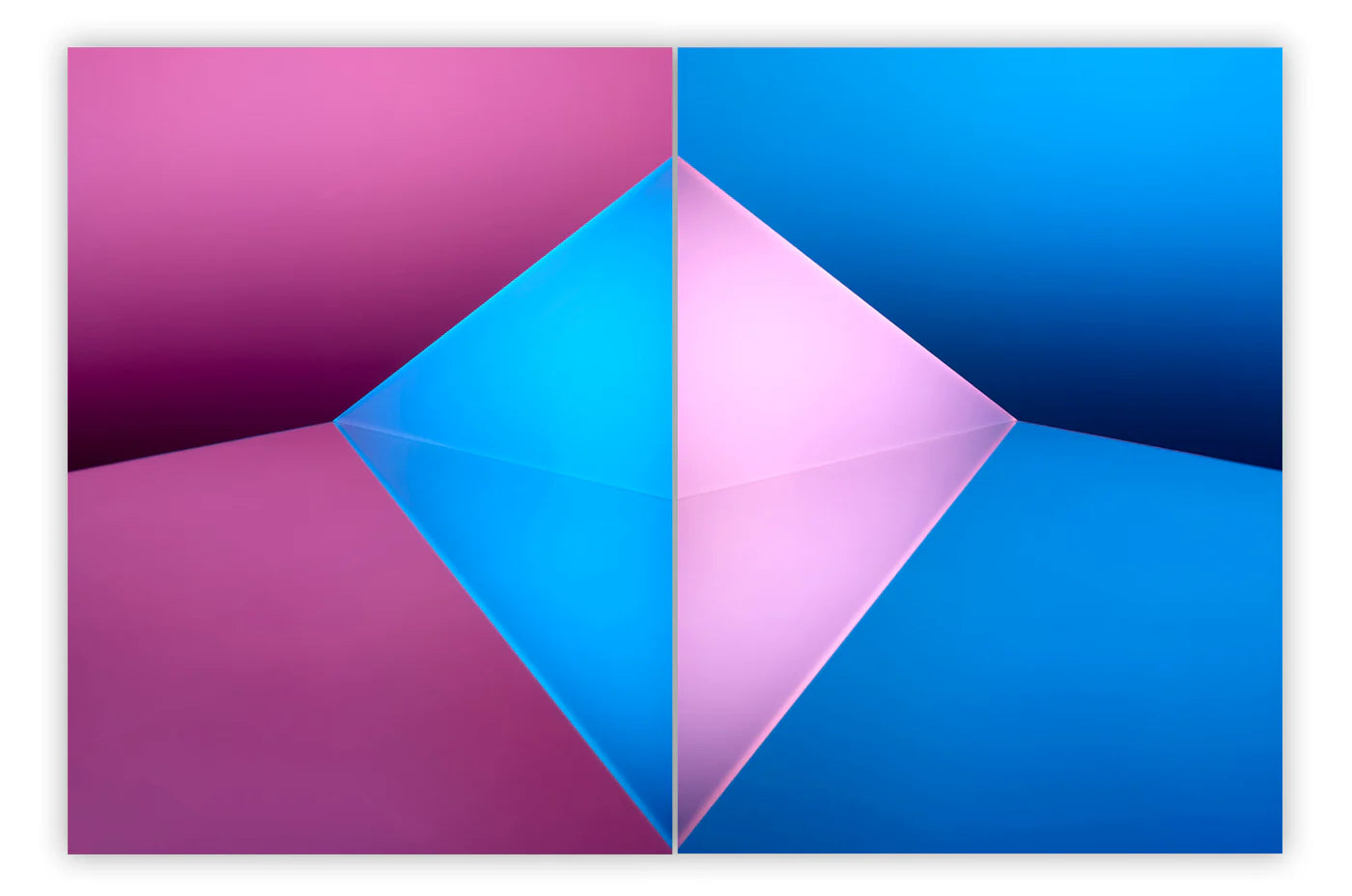
Dutch artist Sebastiaan Knot offers one striking answer. Rather than painting optical illusions by hand, Knot constructs geometric arrangements in his studio, lights them with colored light, and photographs the result. His images look, at first glance, as if they might be digitally rendered. Yet they are produced through physical arrangements, light, and camera-based perception. In doing so, Knot challenges one of photography’s most persistent assumptions: that the camera simply records what is there. His photographs show that photographic truth can itself be constructed, staged, and optically destabilized.

Sebastiaan Knot - Diptych No. 57805 / No. 57806 - 2023
Other artists push perception beyond the rectangle. Louise Blyton uses shaped linen canvases and raw pigment to bring the optical question into three-dimensional form. Her works occupy a space between painting and object. The viewer must negotiate the physical presence of the shaped support and the optical vibration of color. The result is subtle but powerful: perceptual abstraction is no longer confined to a flat picture plane.
This expansion of the toolkit proves that Op Art is not a closed historical style. It is a method of inquiry. Wherever an artist uses form, color, light, rhythm, and structure to activate perception, the Op legacy remains alive.

Louise Blyton - Inside and Outside - 2020
Emotive Geometry and the Subconscious
Op Art is often described as cool, rational, mathematical, and impersonal. That description is partly true, but incomplete. The best optical abstraction shows that strict logic and deep feeling are not opposites. A precisely organized line, a measured interval, or a repeated color sequence can produce emotional effects precisely because it acts directly on perception.
Australian artist Andy Harwood, whose background includes architecture and design, creates works that could be described as emotive geometry. Through careful masking, translucent gradients, and subtle chromatic shifts, Harwood creates compositions that seem to hum with light. His Mesmerism series explicitly engages the mechanics of vision, using repetition, rhythm, and symbolic numerical structures to keep the eye in a state of perceptual flux. The result is not cold calculation. It is a form of sensory tension that can feel meditative, unstable, and quietly emotional.

Andy Harwood - Light Interaction - 2026
A similar psychological intensity can be found in the work of Pierre Muckensturm. Working with a rigorous concrete vocabulary, Muckensturm explores mathematical order, repetition, balance, and spatial harmony. His works do not shout. They draw the eye inward through discipline and restraint. Their power lies in the way they quietly direct attention, creating a structured visual field in which perception becomes slower, deeper, and more conscious.
Together, these artists remind us that geometry is not emotionally neutral. A line can guide the body. A grid can unsettle the mind. A chromatic interval can create tension, calm, rhythm, or unease. Op Art’s psychological force lies precisely in this union of order and instability.

Pierre Muckenstürm - XXIV 33 212 (Diptych) - 2024
The Unfinished Illusion
When Bridget Riley’s paintings were appropriated by the fashion industry in the 1960s and turned into unauthorized patterns for dresses and commercial textiles, she objected strongly. For Riley, optical abstraction was not a passing decorative trend. It was a serious investigation into perception, sensation, and the subjective experience of looking.
History has largely vindicated that position. Op Art was never only about visual tricks. It was about making the viewer conscious of seeing itself.

Bridget Riley - Current (one of the most illegally-copied pattern of the artist - 1963
The artists continuing this legacy today prove that the movement still has urgency. In a culture overflowing with images that ask almost nothing of us, Op Art still demands participation. It requires the viewer to stand, move, adjust, focus, lose focus, and become aware of the body behind the eye.
Op Art has never been about tricking the eye. It is about awakening it.
More Art That Refuses to Stand Still
The contemporary artists featured in this essay, from the physical geometry of Louise Blyton and Pierre Muckensturm to the optical resonance of Cristina Ghetti, Andy Harwood, and Sebastiaan Knot, represent only one part of a broader international field.
For collectors interested in exploring the legacy of perceptual abstraction through works available today, IdeelArt maintains a curated selection of contemporary Op Art and Geometric Abstraction. The collection includes works by the artists mentioned above, alongside international talents such as Richard Caldicott, Brent Hallard, Bernadette Jiyong Frank, Jesus Perea, and kinetic sculptor Amaury Maillet. (see images in the FAQ).
Together, these artists show that Op Art is not a closed chapter of the 1960s. It remains a living language for artists who continue to investigate how the eye sees, how the body responds, and how abstraction can still refuse to stand still.

Jesus Perea - M377 - 2018
FAQ: Anatomy, Theory, and Market of Optical Art
1. What is the scientific and conceptual difference between Op Art and Kinetic Art?
Op Art and Kinetic Art are historically close, and they were often exhibited together, especially in the 1960s. Their mechanisms, however, are different.
Kinetic Art involves real physical movement. The artwork may move through motors, wind, water, magnets, mechanical systems, or direct participation by the viewer. The motion is measurable in physical space.
Op Art generally involves apparent or virtual movement. The artwork itself remains still, but its lines, colors, contrasts, and repeated structures create sensations of vibration, flickering, swelling, rotation, or instability in the viewer’s visual system. The movement is not in the object. It is generated by perception.
In simple terms: Kinetic Art moves physically; Op Art makes the eye and brain experience movement.

Amaury Maillet - Grand Chef - 2023
2. Isn't Op Art ultimately just a vast series of recreational optical illusions?
No. This is one of the most common misunderstandings of the movement.
Traditional optical illusion often tries to deceive the viewer into misreading reality. Trompe-l'œil, for example, may paint a fake window, a fake fly, or a false architectural space. Its success depends on illusionistic deception.
Op Art is different. It is usually abstract and non-objective. Its goal is not to make the viewer believe in a false object. Its goal is to make the viewer aware of the instability and complexity of vision itself.
By using simultaneous contrast, moiré patterns, chromatic vibration, parallax, and retinal fatigue, Op artists reveal that seeing is not neutral. The viewer becomes conscious of perception as an active, bodily process.
So Op Art is not merely recreational. At its strongest, it is a phenomenological investigation into how we see.

Richard Caldicott - Untitled #63 (Tupperware Series) - 1998
3. How do optical artists integrate color theory into their compositions?
Op artists inherited important color theories from earlier modernist movements, especially the Bauhaus. Teachers and artists such as Josef Albers and Johannes Itten studied color not simply as expression or symbolism, but as relation, contrast, vibration, and optical force.
In Op Art, color is often used for its perceptual effect. Complementary colors, tonal equivalence, sharp edges, and repeated chromatic intervals can make surfaces appear to vibrate or shift. The color does not merely fill a shape. It activates the viewer’s vision.
Carlos Cruz-Diez, for example, developed works in which color appears to change according to the viewer’s position. Through parallel bands, chromatic interference, and additive color effects, he created experiences in which color seems to emerge, disappear, or transform in space.
In Op Art, color is not stable decoration. It is an active perceptual event.

Bernadette Jiyong Frank - Migrant (Bordeaux-Green-Gold) - 2023
4. What was the conflict between Bridget Riley, Pop Art, and the fashion industry?
After the success of The Responsive Eye in 1965, Bridget Riley’s black-and-white optical paintings became widely associated with the emerging public image of Op Art. The fashion industry quickly appropriated similar patterns for dresses, fabrics, and commercial design, often without Riley’s permission.
Riley objected strongly. She did not see her paintings as decorative motifs. She considered them serious abstract works rooted in the history of painting and in the subjective experience of vision.
The comparison with Pop Art also troubled her. Pop Art often engaged directly with mass culture, advertising, consumer imagery, and media circulation. Riley’s work, by contrast, was concerned with perception, sensation, and the disciplined construction of visual experience.
The problem was not that Op Art influenced fashion. The problem was that a complex painterly investigation was reduced, almost overnight, to a commercial style.

1960s Magazine scan showing Twiggy, Sandie, Lynn & Lulu
5. What role did France and Paris play in the global development of Op Art?
France, and especially Paris, played a central role in the development of optical and kinetic art.
In the post-war period, Paris attracted many European and Latin American artists interested in geometry, movement, light, and perception. The city became a laboratory for experimental visual art.
The founding of GRAV in Paris in 1960 was particularly important. The group rejected the cult of individual genius and sought to create works based on collective research, simple visual structures, and active viewer participation. In the 1961 tract Assez de mystifications, GRAV explicitly attacked the mystification of art and called for a more direct, accessible, and experimental relationship between artwork and spectator.
Through exhibitions, manifestos, environments, and collective actions, Paris helped transform Op Art from a visual style into a broader philosophical and social project.
6. Who are the most unlikely precursors of Op Art?
Op Art has several unexpected precursors.
One is the history of visual science. Nineteenth-century researchers such as Jan Evangelista Purkyně studied afterimages, retinal effects, and the instability of vision, laying groundwork for later artistic experimentation.
Another is military camouflage. Dazzle camouflage, developed during the First World War, showed that geometric disruption could interfere with the perception of speed, direction, and form.
A third precursor is Marcel Duchamp, whose rotary optical machines explored movement, vision, and circular visual effects. Duchamp’s experiments helped destabilize the idea of the static artwork and opened the way for later investigations into optical movement.
Francis Picabia’s Optophone I from 1921 also anticipated later optical and kinetic concerns through its circular structures and interest in vibratory visual rhythm.
Op Art therefore emerged not from one source, but from the convergence of science, war, modernist abstraction, Dada, Surrealism, and experimental perception.

Francis Picabia - Optophone 1 - 1921
7. How did Op Art influence digital art, cybernetics, and Generative Art?
The relationship between Op Art and digital art is close because both rely on repetition, systems, sequences, and mathematical structures.
Many Op Art compositions can be understood almost algorithmically. They are built from rules: repeated lines, shifting intervals, progressive distortions, modular units, or chromatic systems. This made optical abstraction naturally compatible with early computer art.
In Argentina, the Arte Generativo movement, associated with artists such as Eduardo Mac Entyre and Miguel Ángel Vidal, explored geometric forms as dynamic systems. Their works used repeated curves, rotational structures, and visual sequences that anticipated later computer-generated imagery.
By the late 1960s and 1970s, artists interested in cybernetics and computing began using machines and programming to generate complex visual structures. Op Art helped provide one of the formal languages through which algorithmic art could develop.
Today, the connection continues in digital abstraction, generative art, AI-based image systems, and immersive data environments.

Miguel Angel Vidal - Sin Titulo - 1953
8. Did Op Art influence architecture and spatial design?
Yes. Op Art was never limited to easel painting.
The movement was deeply connected to the modernist belief that art, architecture, design, and everyday life could interact. The Bauhaus had already promoted the integration of visual art, design, craft, and architecture. Op and kinetic artists extended this ambition into perception itself.
Victor Vasarely, for example, believed that geometric abstraction could enter public space and transform the visual environment. The Vasarely Foundation in Aix-en-Provence is a major example of this ambition. It integrates monumental optical works into an architectural setting, turning perception into a spatial experience.
Op Art’s influence can also be seen in murals, façades, public art, interior design, textiles, and spatial installations where pattern and optical vibration alter the experience of built space.

Brent Hallard - Black Only For You III - 2020
9. What is the value of Op Art on today's contemporary art market?
The market for historical Op Art has strengthened significantly over recent decades, especially for major figures such as Bridget Riley, Victor Vasarely, Jesús Rafael Soto, Carlos Cruz-Diez, Julio Le Parc, and François Morellet.
Bridget Riley in particular occupies a major position in the post-war and contemporary art market. Her historical works are rare, institutionally recognized, and represented by leading galleries. Museum attention has helped consolidate her status as one of the most important abstract painters of her generation.
Represented by IdeelArt, Cristina Ghetti is one of the gallery’s leading contemporary artists working in the legacy of Op Art. Her work has also been exhibited in dialogue with several major figures associated with optical, kinetic, and geometric abstraction, making her a particularly relevant reference point for collectors interested in the contemporary continuation of the movement.

Cristina Ghetti - S/T - 2020
The broader market varies considerably. Historical works by major figures command strong prices, while contemporary Op and geometric abstraction can offer more accessible entry points for collectors.
For contemporary collectors, the appeal lies in both visual impact and historical continuity. Op Art remains recognizable, intellectually grounded, and highly adaptable to contemporary interiors.
10. What are the challenges of living with an Op Art piece daily or exhibiting it in a gallery?
Op Art can be extremely powerful, but it requires careful presentation.
Space matters. Many optical works need distance to produce their full effect. A viewer must be able to approach, step back, and sometimes move laterally in front of the work. A cramped hanging can reduce the experience.
Lighting is also crucial. Harsh spotlights may flatten tonal subtleties, create glare, or over-intensify already active contrasts. Diffuse, neutral lighting is often preferable because it allows the work’s internal optical mechanisms to operate without unnecessary visual noise.
Scale also matters. Large Op Art works can dominate a room and create a strong physical presence. Smaller works may be easier to live with, while still producing significant perceptual effects.
The key is to treat Op Art not as decoration, but as an active visual presence.

Richard Caldicott - From left, Untitled #59, 1998; Untitled #169, 2000; and Untitled #63, 1998 -
From the exhibition “Fragile Beauty: Photographs from the Sir Elton John and David Furnish Collection,” V&A Museum, London, 2024.
11. How did Op artists achieve such precision before computers?
Before digital tools, Op artists relied on meticulous manual processes.
They used rulers, compasses, grids, protractors, drawing instruments, architectural methods, and careful mathematical planning. Precision was essential because even small irregularities could change the optical effect.
Masking tape became an important tool, allowing artists to create clean edges between sharply contrasting colors. Acrylic paint also played a crucial role. Unlike oil paint, acrylic dries quickly and can produce flat, uniform surfaces with minimal visible brushwork.
The goal was often to remove traces of expressive gesture. The surface needed to appear impersonal, exact, and almost machine-made, so that the optical effect could dominate the viewer’s experience.
This is one reason Op Art is so remarkable: many works look algorithmic, yet they were achieved through painstaking manual discipline.

Eduardo Mac Entyre - untitled screen print made from a computer generated drawing - 1969 - V&A Museum, no: E.170-2008
12. What is the “horizon effect,” and how does it complicate the history of Dazzle camouflage?
The “horizon effect” refers to the way a ship viewed from a distance can appear to travel along the horizon, making its actual direction harder to judge.
This complicates the history of Dazzle camouflage because it suggests that the success or failure of Dazzle patterns may not have depended only on their striking geometric designs. The visual context of the sea, horizon, distance, light, and movement also played a major role.
Some historical analysis suggests that Dazzle may have worked in some circumstances while being less effective in others. Its visual drama was undeniable, but its military effectiveness remains debated.
For the history of Op Art, however, Dazzle remains important because it showed that abstract geometry could be used to influence perception at a massive scale.
 Francisco SOBRINO - Sans titre - ca. 1960
13. Did Op Art play a role in political resistance during the Cold War?
In some contexts, yes.
During the Cold War, especially in parts of Eastern Europe and Latin America, geometric abstraction, kinetic art, and Op Art could offer alternatives to dominant ideological art forms. In places where Socialist Realism or nationalist figurative traditions were institutionally preferred, abstract art could function as a subtle form of independence.
Because Op Art was rooted in science, mathematics, perception, and objective visual structures, it could sometimes avoid direct political confrontation while still resisting prescribed narratives. It connected artists to international avant-garde networks and allowed them to explore freedom, experimentation, and modernity without necessarily using explicit political imagery.
This does not mean all Op Art was politically resistant. But in certain historical contexts, its refusal of narrative and ideology had political significance.
14. How did art critics react to the rise of Op Art in the 1960s?
Critical reactions were mixed, and often hostile.
The public success of The Responsive Eye was enormous, but many critics were suspicious. Some felt that Op Art was too spectacular, too accessible, or too dependent on optical effects. They worried that it reduced abstract painting to visual entertainment.
Clement Greenberg, the dominant formalist critic of the period, was more interested in other forms of abstraction, especially Post-Painterly Abstraction. Other critics attacked Op Art more directly, seeing it as a fashionable phenomenon rather than a serious artistic development.
The fashion industry’s rapid appropriation of Op patterns made the situation worse. What had begun as a rigorous investigation into perception was quickly turned into a commercial style. This helped create the false impression that Op Art was only a passing trend.
Yet the long-term historical judgment has been more favorable. Major Op and kinetic artists are now recognized as central figures in post-war abstraction.

Richard Anuszkiewicz - Grand Midnight Palace, 1989 (Translumina series)
15. Can Op Art be integrated into permanent monumental architecture?
Yes. One of the clearest examples is the Vasarely Foundation in Aix-en-Provence, inaugurated in 1976.
Victor Vasarely imagined art as something that could enter public space, architecture, and everyday life. The Foundation was conceived not merely as a museum, but as an architectural environment for optical and geometric art.
Its monumental works and hexagonal architectural structure demonstrate that Op Art can operate beyond the canvas. It can shape space, alter movement, and change how the viewer experiences architecture.
This architectural ambition was consistent with Vasarely’s broader belief that art should not remain confined to private collections or elite institutions. It should become part of the visual environment of modern life.

Felipe Pantone - Quick Tide - London
16. Why did Victor Vasarely advocate for “the multiple” rather than the unique masterpiece?
Vasarely believed that art should be more democratic.
The traditional concept of the unique masterpiece made art rare, expensive, and socially exclusive. Vasarely wanted to challenge this model. Through multiples, screenprints, and reproducible systems, he hoped to make high-quality optical art more widely accessible.
This was not merely a commercial idea. It was connected to his constructivist and social vision of art. Because his compositions were based on programmed geometric systems, they could be reproduced without losing their essential structure.
For Vasarely, the multiple was a way to free art from the cult of uniqueness and bring it closer to architecture, design, and everyday life.
17. How did neuroscience foreshadow the visual patterns used in Op Art?
Long before Op Art became a public movement, scientists had already studied many of the phenomena that Op artists would later use.
Visual perception involves the retina, optic nerve, visual cortex, peripheral processing, contrast detection, and constant neural interpretation. Certain patterns can overload or destabilize this system, creating sensations of vibration, flicker, or movement.
In 1957, neuroscientist Donald M. MacKay created patterns now known as MacKay rays: tightly packed radial lines that can produce shimmering or hallucinatory movement in peripheral vision. Such examples showed that specific geometric arrangements could trigger predictable visual effects.
Op artists did not need to use scientific language to exploit these effects. But their works often correspond closely to known principles of visual processing.

Optical Illusion (Author unknown)
18. What does Op Art owe to the Bauhaus?
Op Art owes a major debt to the Bauhaus tradition.
The Bauhaus treated art, design, architecture, color, and visual perception as interconnected fields. Teachers such as Josef Albers and Johannes Itten investigated how colors interact, how forms relate, and how perception can be structured through visual education.
Josef Albers’ work on the interaction of color was especially influential. He showed that color is never perceived in isolation. A color changes according to the colors around it. This insight became central to many optical and geometric artists.
Victor Vasarely also studied at the Mühely Academy in Budapest, often described as a kind of “Budapest Bauhaus.” There, he absorbed ideas about geometry, communication, modern design, and the social role of visual form.
The Bauhaus provided much of the theoretical foundation that Op Art later intensified.

Carlos Cruz Diez - Physichromie N.1977 - 2015
19. Who are the artists defining contemporary Op Art and perceptual abstraction today?
Contemporary Op Art is not a single movement in the strict historical sense, but a broad field of artists exploring perception, geometry, color, movement, and optical instability.
Some artists extend the legacy through painting. Cristina Ghetti uses geometric rhythm and spatial vibration to create contemporary optical fields. Andy Harwood explores chromatic gradients, masking, and perceptual flux. Pierre Muckensturm works with restrained concrete structures and mathematical harmony.
Others expand the field through photography, shaped canvas, sculpture, or digital aesthetics. Sebastiaan Knot constructs photographic illusions from light and physical geometry. Louise Blyton uses shaped linen and raw pigment to create object-like optical works. Felipe Pantone brings the language of digital screens, glitches, and technological acceleration into geometric abstraction.
The field also includes artists such as Brent Hallard, Bernadette Jiyong Frank, Jesus Perea, Richard Caldicott, Suzanne Song, among many others.
Together, these artists show that Op Art’s legacy remains alive, flexible, and highly contemporary.
20. Did Bridget Riley embrace the title “Queen of Op Art”?
No. Bridget Riley resisted the label “Op Art” and the celebrity image that came with it.
Riley has consistently presented herself as an abstract painter concerned with perception, sensation, visual rhythm, and the emotional experience of looking. The “Op Art” label was useful for the press, but it also simplified her work and associated it with commercial optical effects.
The unauthorized use of Riley-like patterns in fashion deepened her discomfort. Her paintings were being reduced to a style, while her real concern was the complex subjective experience produced by abstract form.
Riley’s resistance to the label is important because it reminds us that Op Art was never merely a brand. At its best, it was, and remains, a serious investigation into the act of seeing.

Bridget Riley - Movement in Squares - 1961
By Francis Berthomier
All images © The Artists


