
Georgiana Houghton at The Courtauld Institute
History nearly forgot Georgiana Houghton. She was an anomaly: an Impressionist-era painter creating purely abstract works of art 50 years before Wassily Kandinsky claimed to have pioneered the idea. A spiritual medium, Houghton insisted that the dead guided her hand when she painted, and that the resulting abstract images held transcendent messages from the spirit realm. IdeelArt had the pleasure of viewing Houghton’s paintings at the exhibition Georgiana Houghton: Spirit Drawings, which was on view in 2016 in the gallery of London’s Courtauld Institute. The exhibition marked the first time Houghton’s work has been publicly shown in nearly 150 years.
Georgiana Houghton vs. History
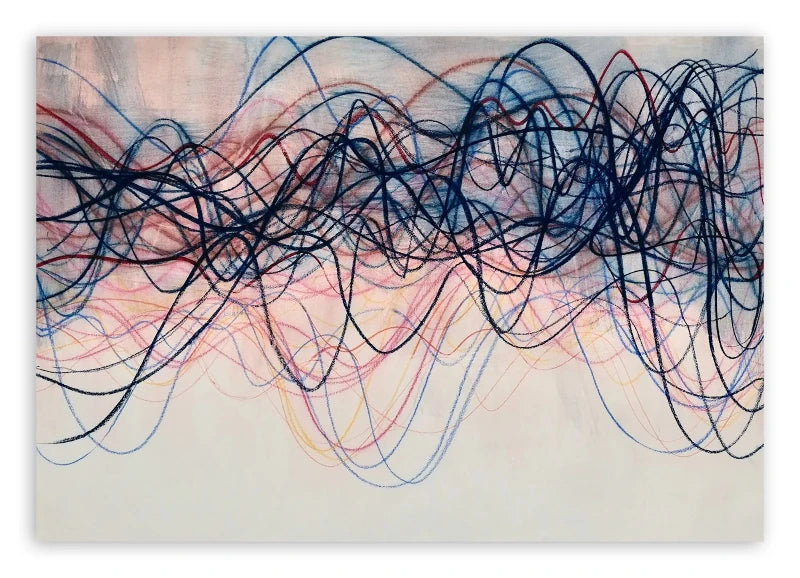
It seems fitting that Houghton’s paintings would make their contemporary debut at the Courtauld Institute. It is, after all, one of the world’s premier institutions for the study of art history. Houghton’s work directly challenges everything we thought we knew about the history of abstraction in Western art. As the Courtauld’s own collection of Impressionist and Post-Impressionist makes clear, every well-known European painter in Houghton’s time was making figurative work. While Monet and Cézanne captured the beauty and light of the visible world, Houghton was channeling the unseen, creating some of the most luminous, complex, layered abstract paintings ever made.
This exhibition makes it clear that Houghton did not wish to explain the specific content of her paintings. Titles and brief notations on the backs of some of the works make reference to the spirits she claimed guided her in making the piece. But she left it to viewers to interpret the meaning of the images. Houghton, like so many other abstract artists since, hoped her visual language would be clear to those who were open to receiving it, and that viewers would be able to interpret the symbols and imagery in a meaningful and personal way.

Georgiana Houghton - The Glory of the Lord, 1864, watercolor and gouache on paper
A Master of Color and Line
Entirely aside from the spiritual element of her practice, Houghton’s aesthetic accomplishment was astonishing. Her compositions display a harmonious sense of balance. Her kaleidoscopic mastery of color in paintings like The Glory of the Lord prefigures the Modernist masterpieces of Fauvism and Orphism. The intricacy and grace of her line work seems almost impossible to have been achieved by hand. One anecdote posted in the show indicates that many of these works were made while Houghton conversed with visitors, making them even more bewildering, and perhaps lending credence to her claim that she was not entirely in control of what she was painting.
In so many of Houghton’s works we see echoes of the brilliance of other abstract artists that would not yet arrive for another century. Her free and whimsical use of line in The Monogram of Cromwell Varley evokes Cy Twombly. The delightfully transcendent palette in The Flower of Samuel Warrand prefigures that of Mark Rothko’s color fields. The intuitive, subconscious freedom of The Sheltering Wing of the Most High rivals the best efforts of Jackson Pollock and the Abstract Expressionists. But Houghton’s unique vision puts her into a category all her own. To witness this remarkable addition to the canon of abstraction, one could visit Georgiana Houghton: Spirit Drawings, on view through 11 September 2016 at The Courtauld Gallery at London’s The Courtauld Institute of Art.
Featured Image: Georgiana Houghton - The Sheltering Wing of The Most High, 1862, Watercolour and Gouache on Paper
All images used for illustrative purposes only
By IdeelArt Editorial
Sources
- Georgiana Houghton: Spirit Drawings (The Courtauld): the institution’s page for the exhibition, 16 June to 11 September 2016, her 1871 Bond Street show and the spirit inscriptions on the backs of the works.
- Works by Victorian Spiritualist Artist Georgiana Houghton on View in London for First Time in 150 Years (Artnet News): independent coverage of the Courtauld show, her dates (1814 to 1884) and the spirits she credited on the backs of her works.
- Georgiana Houghton: Spirit Drawings (Apollo): independent preview covering her 1871 exhibition of 155 works and her claim that spirits guided her hand.