文章: Claude Viallat: The Ultimate Guide to Colour, Repetition and Painting Without a Frame
Claude Viallat: The Ultimate Guide to Colour, Repetition and Painting Without a Frame
Claude Viallat has spent six decades repeating a form that refuses to tell us what it is. Resembling a knucklebone, a bean or a small piece of sponge, it is immediately recognisable without being a picture of an identifiable subject. Across unstretched cloth, industrial tarpaulins, curtains and salvaged textiles, this modest shape has become the organising principle of an expansive inquiry: what can painting do when it stops describing the world and begins exposing its own materials?
The apparent simplicity is deceptive. Viallat did not merely invent a motif and turn it into a signature. He changed the relationship between paint and cloth, between a painting and its surroundings, and between an artist's decision and the accidents of making. His work can be exuberantly colourful while remaining materially radical. It can evoke decoration while unsettling the boundary between ornament and art. Above all, it demonstrates that repeating something is not necessarily the opposite of discovering something.
A founding member of Supports/Surfaces and its major figure, Viallat is among the most important living abstract painters in France and occupies an essential position in post-war French painting. Yet his achievement exceeds the history of that movement. The continuing variety of his work, including exhibitions marking the motif's sixtieth anniversary in 2026, makes a compelling case for looking beyond the familiar label. This guide examines his development, the logic of his repeated form, the material life of his paintings, his objects and exhibitions, and the questions collectors should ask.
Claude Viallat: Quick Facts
- Born: 1936, Nîmes, France.
- Based in: Nîmes.
- Training: École des Beaux-Arts, Montpellier, 1955–1959; École des Beaux-Arts, Paris, 1962–1963.
- Teaching: Director of the École des Beaux-Arts de Nîmes from 1979; later taught at the École des Beaux-Arts in Paris, from 1991.
- Historical association: Founding member and major figure of Supports/Surfaces.
- Signature motif: An irregular, nonrepresentational form first developed in the summer of 1966.
- Principal materials: Paint on unstretched canvas, tarpaulins and reused textiles; also ropes, nets, wood and other objects.
- Major international milestone: French Pavilion, 43rd Venice Biennale, 1988.
- Selected public collections: Centre Pompidou, Carré d'Art in Nîmes, Musée Fabre in Montpellier and the Museum of Modern Art in New York.
- Recent milestones: Carré d'Art's Et pourtant si… exhibition in 2023–2024; exhibitions celebrating sixty years of the motif in 2026.

Claude Viallat, Parasol. A masterpiece of the found support. The parasol supplies the architecture, the form supplies the rhythm, and between them a flower appears that nobody painted. Viallat would say there is no flower, only a painting. He is right, but it blooms anyway. © Claude Viallat
1. Formation: From Nîmes to the Discovery of the Form
Training and the Question of What a Painting Is
Viallat was born in Nîmes in 1936. His formal education took him first to Montpellier and then to Paris, where he studied in the early 1960s. Ceysson & Bénétière's biography identifies his encounter with fellow artists such as Michel Parmentier and his interest in American Abstract Expressionism, particularly Jackson Pollock, as important elements of this formation.
Pollock offered more than a vocabulary of gestures. His practice suggested that painting could be understood through the act of making and the organisation of an entire field rather than through a depicted scene. For Viallat, however, the response would not be to reproduce Pollock's drips. It would be to reduce the means of producing a painted image and investigate what remained available for variation.
This distinction matters. Viallat's repeated form is not a heroic flourish announcing the painter's personality with every stroke. It establishes a recurring unit against which differences become visible. Gesture persists, but it is distributed through placement, colour, pressure and the physical response of the support.
The Summer of 1966: An Accidental Form Becomes a Working Principle
The summer of 1966 is the pivotal date in Viallat's practice. In an essay accompanying the 2026 Ceysson & Bénétière exhibition His Form Is Sixty Years Old, Bernard Ceysson recounts the artist's search for a simplified method of applying colour. The account connects that search to domestic wall decoration in Aubais, where repeated motifs could be applied to whitewashed walls with a sponge, cloth or patterned roller.
According to the account, Viallat experimented with a piece of polyurethane foam, initially cut into a roughly palette-like shape. After it was left in a strong bleach solution, the foam broke apart. He retained the largest surviving fragment and adopted the resulting outline as his recurring form. The story places accident at the foundation of a practice often mistaken for strict systematic control.
 Claude Viallat, CF 2.6.13, 1966. The repeated form is already present, but hasn't yet reached its final shape. © Claude Viallat.
It is best understood as a documented account of the motif's emergence, rather than as a licence to explain every subsequent work through a single anecdote. The decisive artistic act was not simply accepting an accidental shape. It was choosing to work with that shape for decades, discovering how much could change around it.
2. The Motif: Repetition as a Method of Discovery
What Does the Viallat Shape Represent?
Descriptions of the motif proliferate: knucklebone, bean, sponge, organic fragment. They are useful visual comparisons, but none supplies a definitive subject. Its power lies partly in that uncertainty. The shape is neither a geometrically neutral square nor an image that settles into a narrative.
 Detail of a yellow fabric: one form, repeated, never quite the same twice. © Claude Viallat
Calling it a bean tells us something about our desire to recognise familiar objects. It does not exhaust what the form does in a painting. Viallat's repeated mark creates intervals, establishes rhythms, carries colour and interacts with whatever is already present in the textile. Its function is relational before it is symbolic.
Why Keep the Same Form?
Fixing one element expands the importance of others. If the painter does not have to invent a new figure for each canvas, attention can shift to the density of colour, the spacing between marks, the resistance of the cloth and the relationship between painted and unpainted areas.
The repetition is not equivalent to mechanical duplication. Ceysson's 2026 essay distinguishes between solid and hollowed-out stencils and stresses that no occurrence is exactly the same. A recurring outline can produce filled forms, contours or interactions with existing patterns. The method establishes continuity without demanding uniformity.

In the stairwell of the Hôtel des Arts TPM, a suspended yellow banner multiplies the same form from top to bottom. © IdeelArt
This is why the motif should not be dismissed as branding, even though it makes the work recognisable. Recognition is only the beginning. The more rewarding question is what this particular occurrence permits us to see that another did not.
How the Form Evolves
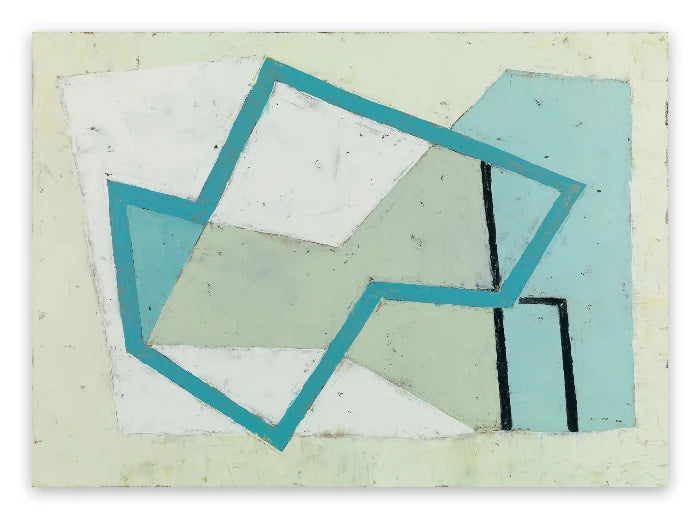
The form stays the same, but the way it is deployed does not. In the 1960s the stencilled mark is widely spaced, leaving generous areas of bare cloth between one occurrence and the next, and the blue 1966 work shown above belongs to that early moment, when the outline itself was still settling. Over the following decades the marks become more concentrated, the range of colours widens, and the motif is sometimes combined with printed upholstery fabrics. A modest, almost neutral shape keeps renewing itself, and can become exuberant. It adapts to any support, and it is both the background and the form of the work.
A Painting as a Fragment of Something Larger
In the text for Templon's 2026 Brussels exhibition, Viallat describes the possibility of an enormous ideal canvas from which individual works might be fragments. This helps explain the way repetition can suggest continuation beyond an edge. A painting need not organise itself around one privileged centre or provide a neatly closed visual statement.
That idea also changes how an exhibition is experienced. Works can reverberate across a room, sharing a vocabulary without becoming interchangeable. The viewer encounters both a distinct material object and a contribution to a much larger, potentially continuing field.
Display follows the same logic. Because the cloth is not tied to a frame, the same work can be presented differently from one venue to the next: wrapped around a column, suspended from the ceiling, or laid on the floor like a coloured path. Monumental scale is available whenever the space calls for it.
3. Supports/Surfaces: Taking Painting Apart
What the Movement Challenged
Supports/Surfaces emerged around the turn of the 1970s as an investigation into painting's constituent elements. The name directs attention to what conventional viewing tends to overlook: the support that carries paint and the surface on which an image appears.
Artists associated with the movement include Vincent Bioulès, Louis Cane, Daniel Dezeuze, Jean-Pierre Pincemin and Noël Dolla. Their approaches differed. The movement should not be reduced to a single technique, nor should every work by one of its members be treated as an illustration of a shared programme.
What connects the investigations is a willingness to question painting's supposedly natural conventions. Why must cloth be pulled taut over a wooden stretcher? Why must a painting be a bounded rectangle? Why should the material beneath the image remain visually subordinate to it?
Supports/Surfaces was among the most radical movements in post-war French art. Rather than asking what a painting should represent, it asked what a painting is made of, and it treated the stretcher, the canvas, the frame and the paint as subjects in their own right.
For a deeper look at how the movement evolved and why its questions still matter for contemporary painting, read our in-depth essay The Neo Supports/Surfaces: A Manifesto for Material Realism in the 21st Century.
Viallat's Particular Contribution
Within this group, Viallat holds a particular place. A founding member, he is today the best known of the Supports/Surfaces artists, and the one whose work is most widely exhibited and collected. Others, among them Dezeuze, Dolla or Pincemin, pursued their own questions with comparable consistency, by different means. But Viallat’s repeated form, maintained for well over half a century, has become the movement’s most recognisable image.
What makes his work central to the movement, beyond its fame, is how directly it enacts the movement’s questions. By abandoning the stretcher, Viallat makes the answers visible: the cloth is no longer pulled taut, the painting is no longer a bounded rectangle, and the support is no longer hidden behind the image. Released from a rigid frame, fabric retains its flexibility.
For the viewer, the effect is not merely a change in format. A fold creates shadow. An irregular edge redirects attention. A seam interrupts a rhythm. The painting's construction becomes part of the encounter rather than something hidden behind it.
Politics, Economics and the Everyday
Supports/Surfaces had both theoretical and political dimensions, but Viallat's use of ordinary materials also has a practical history. Ceysson's 2026 essay emphasises the economic advantages of dispensing with stretchers: cloth could be folded, stored and transported more cheaply.
This material economy complicates a purely ideological reading. A discarded tarpaulin is not simply an emblem of opposition to luxury. It is an available material with a shape, a history and specific possibilities. Viallat's transformation of such materials brings painting into contact with everyday use without requiring the work to illustrate a political message.
 A painted textile made from advertising cloth bearing the Ricard name. Everyday material becomes the support. © Claude Viallat
4. Painting Without a Stretcher: Cloth, Colour and Memory
The Support Is Not a Blank Beginning
Sheets, rugs, curtains, industrial tarpaulins and recycled textiles are among the materials documented in Viallat's practice. Unlike a standard primed canvas, a reused fabric may already contain colour, a printed pattern, stitched joins, borders or signs of wear.
The painter therefore begins in conversation with something that is not empty. The repeated motif can coincide with an existing pattern, interrupt it or create a second rhythm across it. The support acts less like a neutral stage than an active participant.
These supports are often worn and come from everyday use: tent canvas, parasols, awnings, boat covers, deckchair fabric. Viallat works on them flat on the studio floor, spreading the cloth out and stepping onto it when necessary. The work is made horizontally, from above, and only becomes upright when it is shown.
 Exhibition view, Ceysson & Bénétière, Saint-Étienne, 2026: painted sheets, a net of ribbons, a rug laid on the floor, a cut circular cloth and a fringed curtain with a tassel. One form, many supports. © Ceysson & Bénétière.
Looking at these works requires attention to two intertwined histories: the history of what the cloth was and the history of what painting has done to it. Neither necessarily cancels the other.
Edges, Seams and Gravity
A conventional frame establishes where a painting ends. Viallat's textiles can inherit their boundaries from an earlier function: an awning, a curtain, a bag or an assembled piece of cloth. Seams and shaped edges may remain integral to the work.
This is one reason stretching such a painting can be conceptually consequential, not merely a convenient way of hanging it. Turning flexible cloth into a rigid rectangle may change the relationship between painted form, textile structure and surrounding space.
The absence of a stretcher also introduces gravity as a visible factor. Painting is no longer only a matter of arranging marks across an imagined flat plane. It becomes an object occupying an actual room.
 Hung without a stretcher: the shaped edge, the inserted zigzag band and the seams all remain part of the picture. © Claude Viallat
Reuse Without Reducing the Work to an Environmental Message
Contemporary viewers may connect Viallat's salvaged materials with debates about consumption and reuse. That connection can be productive, provided it does not replace the history of the work. The material investigations developed in the 1960s and 1970s, within specific artistic, practical and political circumstances.
His paintings are not simply demonstrations that discarded things can become beautiful. They ask how a material's previous identity survives its passage into art, and how painting can alter that identity without making it disappear.
5. Colour, Matisse and the Question of Decoration
Colour as a Relationship, Not a Label
Once the motif becomes familiar, colour becomes increasingly difficult to treat as an accessory. It establishes the force of a mark, distinguishes one interval from another and changes how the underlying textile is perceived.
A colour does not operate in isolation. Its effect depends on its neighbours, the texture beneath it and the amount of surrounding cloth left visible. Viallat's method makes such relationships central: the recurring form offers a degree of continuity against which chromatic differences become legible.
 Orange, yellow and olive: colour works as a relationship between panels, not as a label.
© Claude Viallat
The Continuing Conversation with Matisse
Viallat's relationship with Matisse is documented through exhibitions including Hommage(s) à Matisse at the Musée Matisse in Le Cateau-Cambrésis in 2005 and subsequent presentations listed in his exhibition history. Ceysson's 2026 essay also places recent works in conversation with Matisse's The Red Studio.
The connection should not be reduced to shared bright colour. It concerns the capacity of colour to organise an entire pictorial environment, and the possibility that pattern can carry serious artistic thought rather than serving as background embellishment.
Viallat's distinctive contribution is to pursue that possibility through a repeated unit and a physically exposed textile. Where the support has its own pattern or prior use, colour works within an already active field.
Is It Decorative?
The question is unavoidable, and dismissing it too quickly misses something important. Repeated motifs, textile surfaces and chromatic pleasure do connect Viallat's work to decoration. Yet that connection is not evidence that the paintings lack intellectual ambition.
The issue is what decoration is allowed to mean. If ornament must remain secondary to an image, Viallat's work disrupts that hierarchy. Pattern becomes the means through which the painting investigates its own surface, its boundaries and the viewer's attention.
These works can be pleasurable to live with while challenging the assumptions behind that pleasure. Visual generosity and formal analysis are not mutually exclusive.
« Surtout pas le convenu, le convenable à la rigueur, mais l’inconvenant, oui. Parce que ce n’est pas la convention. »
Above all, not the conventional; the proper, at a pinch; but the improper, yes. Because it is not convention.
Claude Viallat, interview with Martin Pierlot, 2014 (wall text, Hôtel des Arts TPM, Toulon)
6. Ropes, Nets and Objects: Painting Beyond the Rectangle
Viallat's objects are not a minor supplement to his paintings. Templon's 2026 exhibition text dates his exploration of objects to as early as 1969 and describes materials including driftwood, rope and planks. His exhibition history also repeatedly identifies nets and hoops as areas of investigation.
 Fabric panels joined by orange straps: the work leaves the rectangle and becomes an object on the wall. © Claude Viallat
These materials allow the logic of painting to be considered outside the continuous surface of cloth. A net presents repetition and intervals without a solid ground. A rope traces a line in actual space. A hoop establishes a boundary whose interior may remain open.
 A ribbon of green cloth with painted red outlines, hung as an open diamond: painting reduced to its edges. © Claude Viallat
The relationship to the paintings is therefore structural, not simply stylistic. Both bodies of work explore how an ordinary material can organise space and how a limited procedure can generate an encounter. They move between painting and object without making the distinction irrelevant.
They also make the viewer's movement more important. The work may be apprehended not only from a single frontal position, but through changing relationships among its materials, the wall and the surrounding room.
7. Selected Works and Ways of Looking
Viallat's work is often identified through dates and numbers rather than descriptive titles. A useful guide should therefore avoid forcing the career into a list of supposed iconic masterpieces. The following documented examples show how the choice of support creates distinct questions. Their material information comes from Templon's 2026 exhibition listing.
Sans titre n°87, 2026: Acrylic on a Duffel Bag

Claude Viallat, Sans titre n°87, 2026. Acrylic on a duffel bag
© Claude Viallat
Listed at 152 × 152 cm, this work demonstrates how far the category of a painting support can expand. A duffel bag enters the work with a prior function rather than as an anonymous piece of canvas. The relevant question is not only what has been painted, but how the former object has been opened, presented or transformed into a pictorial field.
Without treating its support as an anecdote, the work asks us to consider how use and image-making overlap. The fabric's identity belongs to the painting's material logic.
Sans titre n°80, 2026: Acrylic on Fabric

Claude Viallat, Sans titre n°80, 2026. Acrylic on fabric
© Claude Viallat
The listed dimensions, 245 × 114 cm, establish a markedly elongated format. Such proportions provide a useful reminder that the repeated motif does not belong exclusively to a standard canvas rectangle. The support's scale and shape participate in the way repetition can be experienced.
A productive viewing question is how the rhythm negotiates the boundary: does the eye register a closed composition, or something that seems to continue beyond the cloth? The answer needs to be discovered in the work rather than assumed from the method.
Sans titre n°51, 2025: Acrylic on an Assembled Fabric Support

Claude Viallat, Sans titre n°51, 2025. Acrylic on assembled fabric support
© Claude Viallat
Templon lists this work as acrylic on a fabric mounting, at 130 × 125 cm. The entry points towards another important aspect of the practice: the support may be assembled rather than given as a single neutral sheet. Material joins can introduce a structure with which painted repetition must coexist.
Assembly changes the meaning of continuity. The viewer encounters not only the recurrence of a shape, but the relationship between a repeated procedure and a physically constructed ground.
Sans titre n°36, 2026: Acrylic on a Sheer Curtain

Claude Viallat, Sans titre n°36, 2026. Acrylic on a Sheer curtain
© Claude Viallat
Listed as acrylic on a stripped sheer curtain, at 113 × 116 cm, this work places a domestic textile within the inquiry. A curtain belongs to an architecture of openings, light and separation. Its use as a support expands the conversation beyond the conventional opacity of a canvas.
The significant point is not that the painting secretly depicts a window. It is that the material carries associations and physical properties that painting can engage without illustrating them.
How to Look Beyond the Signature
Begin with the whole object, not the motif alone. Notice its proportions, edges and relationship to the wall. Then distinguish the textile's existing structure from the painted additions. Follow the intervals between forms as carefully as the forms themselves. Finally, return to the whole: how has a repeated procedure changed your experience of this particular material?
This sequence prevents recognition from becoming the end of looking. The familiar outline is a point of entry into differences, not a reason to stop paying attention.
8. Exhibitions, Collections and Continuing Recognition
From the French Pavilion to Major Retrospectives
Viallat represented France at the 43rd Venice Biennale in 1988, a major international milestone documented in his gallery exhibition history. A retrospective at the Musée Fabre in Montpellier in 2014 offered another significant occasion to consider the breadth of his practice.
His works are held in numerous public collections. Ceysson & Bénétière's collection list includes the Centre Pompidou, Carré d'Art, Musée Fabre, the Musée d'Art Moderne de Paris and MoMA, among others. Collection membership should not be confused with a promise that a particular work is currently on display.
Et pourtant si… at Carré d'Art
Carré d'Art's exhibition archive records Et pourtant si… from 27 October 2023 to 3 March 2024. For an artist rooted in Nîmes, the exhibition places institutional recognition within a long-standing local context rather than treating the city as a biographical footnote.
Nîmes matters as a continuing base for production and reception. Viallat's international career does not require the disappearance of the regional circumstances from which his material and visual interests developed.
Teaching and the Question of an École de Nîmes
Viallat's influence is not limited to his own work. In 1979 he became director of the École des Beaux-Arts de Nîmes, where he taught a generation of students ideas about painting that were radical for their time. Alain Clément, who shared many of his views on dismantling the conventions of painting before taking a slightly different path, taught at the school from 1979 and directed it from 1985 to 1990, after Viallat. Whether one can speak of an École de Nîmes is debatable, but Viallat's influence on the French art scene is not. Among his students in Nîmes were Guillaume Moschini and Jean-Daniel Salvat. He later taught at the École des Beaux-Arts in Paris, where Frédéric Prat was among his students.
2026: Sixty Years of the Form
The motif's sixtieth anniversary coincided with an unusually dense programme of exhibitions across France and Belgium in 2026. Six presentations, spanning galleries, art centres and historic sites, reinforced Viallat's dual stature as a historic figure and a continuously productive artist. Rather than a single commemorative retrospective, the programme offered complementary encounters with the long development of the form, recent textile paintings, objects and a less familiar body of work on bullfighting themes.

Exhibition poster: Avatar 2005–2025, Clin d'œil à Jean Fournier, 20 December 2025 to 25 April 2026. © IdeelArt
The year opened at the Hôtel des Arts TPM in Toulon with Avatar 2005–2025, Clin d'œil à Jean Fournier (20 December 2025–25 April 2026), a two-decade survey presented as a tribute to Viallat's historic gallerist Jean Fournier. At the Château du Bois Orcan near Rennes, Oniris gallery presented around fifty recent works in dialogue with the restored medieval estate (4 April–1 November 2026), twenty-two years after Viallat created the stained-glass windows of the site's Saint-Julien Chapel.

Claude Viallat - Avatar 2005-2025 - Exhibition shot ©IdeelArt
Two gallery exhibitions marked the anniversary explicitly. Ceysson & Bénétière Saint-Étienne presented Claude Viallat: His Form Is Sixty Years Old. 1966–2026. Tribute to Henriette Viallat (6 March–23 May 2026), curated by Bernard Ceysson and Arlette Klein, as part of the gallery's own twentieth anniversary. Viallat had been the first artist it exhibited in Saint-Étienne twenty years earlier. The exhibition proposed one, two or three canvases for each of the sixty years, making continuity and variation visible across the full duration of the practice. From 22 April to 26 June 2026, Templon Brussels followed with around thirty experimental canvases produced between 2024 and 2026, alongside objects.
Two further presentations extended the programme through summer and autumn. At the Abbaye du Ronceray in Angers, a recently reopened historic site, around twenty monumental free-hanging canvases engaged directly with the architecture (25 June–17 October 2026). At the Espace Michèle Goalard in La Grande-Motte, Retours en boucles – Taureau / Forme (10 July–30 August 2026) offered a less familiar perspective on the career, including fourteen previously unseen panels on bullfighting themes, a subject that has long accompanied Viallat alongside his abstract work. It is also a reminder that the recurring motif is not the whole story.

"Claude Viallat" - Templon Brussels exhibition shot - 2026
Taken together, these presentations challenge the assumption that longevity necessarily means repetition without discovery. Bernard Ceysson's 2026 essay for the Saint-Étienne exhibition describes works made in January 2026 in which one textile was placed over another and the drawing and paint transferred through their contact. The resulting interaction complicates the relationship between an actual overlay and the appearance of layered pictorial planes, demonstrating that six decades after the motif's emergence, Viallat was still extending the formal possibilities of his method.
9. Collecting Claude Viallat
Start with the Specific Work
For a collector, recognising the motif is not enough. Date, support, dimensions, technique, provenance, condition and intended presentation all contribute to understanding an individual work. Two paintings bearing the same recurring form may occupy very different positions in the practice and make very different demands on a room.
A major textile painting, a work on paper, an edition and an object should not be treated as equivalent simply because the artist's name is the same. Confirm the medium and whether the work is unique or belongs to an edition, then assess the quality and completeness of its documentation.
Condition and the Intended Life of the Textile
Reused cloth makes condition assessment particularly nuanced. A seam or mark of wear may predate the painting and form part of the chosen support. Conversely, later tears, fading, inappropriate repairs or damage to paint can be significant issues. Those distinctions should be documented rather than guessed from a photograph. This matters especially with Viallat, whose loose execution can sometimes make a work feel as if something went wrong: he does not mind walking on his own paintings while working on them, and sometimes leaves marks.
Ask for a condition report and guidance on hanging, handling, transport and storage. For unstretched works, presentation is part of the discussion: a collector should not assume that mounting the fabric on a stretcher or placing it behind glass is a neutral alteration. Consult the gallery and an appropriately qualified conservator about the particular object.

Claude Viallat - Artwork detail - When a brand new painting can feel dirty or stained...
Value Without Unsupported Price Claims
There is no single meaningful price for a Claude Viallat artwork. Comparisons need to account for medium, scale, date, provenance, condition and the relevant sales context. An auction estimate, a hammer price and a gallery asking price are different types of information.
This guide does not propose a price range or investment forecast without a dated, verified set of comparable sales. The stronger collecting case is artistic: Viallat provides a historically significant and sustained examination of painting whose material differences reward close attention.
10. Why Viallat Matters Today
Viallat's continuing relevance lies less in the number of artists who might imitate his motif than in the possibilities opened by his method. Painting need not conceal its support. A familiar procedure can remain open to accident. Ordinary materials can carry intellectual ambition without losing their everyday character.
Templon's 2014 exhibition text discusses the renewed relevance of Supports/Surfaces to contemporary American abstraction, citing critical comparisons with artists including Gedi Sibony, Matt Connors and Blake Rayne. These affinities should be understood as a critical discussion of material and procedural concerns, not as proof that every related artist directly follows Viallat.
For IdeelArt readers, his practice offers a particularly valuable way of looking at abstraction. Instead of asking only what an image resembles, we can ask what it is made from, which decisions remain constant, what changes, and how the object affects the space around it.
That is the achievement concealed within the recurring shape. By making one element familiar, Viallat makes the rest of painting unfamiliar again. The motif is not the conclusion of the work. It is the instrument through which the work continues to begin.

Claude Viallat with Christelle Thomas, co-founder of IdeelArt, in front of one of his repeated-form banners at the Hôtel des Arts TPM, Toulon, December 2025. © IdeelArt
Francis Berthomier
Featured Image: Claude Viallat (artwork detail)
Claude Viallat: 20 Frequently Asked Questions
1. Who is Claude Viallat?
Claude Viallat is a French artist born in Nîmes in 1936 and a founding member and major figure of Supports/Surfaces. He is best known for repeating an irregular abstract motif on unstretched canvas, tarpaulins and reused textiles, while investigating colour, material and the boundaries of painting.
2. Where did Claude Viallat study?
He studied at the École des Beaux-Arts in Montpellier from 1955 to 1959 and at the École des Beaux-Arts in Paris from 1962 to 1963. His subsequent development combined an interest in American abstraction with an increasingly direct examination of painting's physical materials.
3. When did Viallat begin using his signature motif?
The motif emerged in the summer of 1966. Exhibitions at Ceysson & Bénétière and Templon marked its sixtieth anniversary in 2026, demonstrating the continuing importance of that decision across six decades of work.
4. How was the motif invented?
In Bernard Ceysson's account, Viallat experimented with polyurethane foam for applying colour. After a strong bleach solution damaged the foam, he retained its largest surviving fragment and adopted the accidental shape. The account also connects the method to repeated motifs used in domestic wall decoration in Aubais.
5. What does the Viallat shape represent?
It is often compared with a knucklebone, bean or sponge, but it has no fixed representational meaning. Its main function is pictorial: it carries colour, creates rhythm and interacts with the material on which it appears. The comparisons describe resemblance rather than a definitive subject.
6. Why does Viallat repeat the same shape?
Keeping the outline relatively constant directs attention towards other variables, including colour, spacing, texture and the support. Repetition becomes a method of noticing difference. The procedure is recognisable, but individual occurrences and individual works need not be identical.
7. What is Supports/Surfaces?
Supports/Surfaces is a French movement that emerged around the turn of the 1970s and examined painting's basic components, particularly supports, surfaces and materials. Its artists questioned conventions such as the stretched canvas and the bounded rectangle, through different practical and theoretical approaches.
8. Was Claude Viallat a founding member of Supports/Surfaces?
Yes. Both Templon and Ceysson & Bénétière identify him as a founding member. His unstretched textiles and repeated motif constitute a distinctive contribution to the movement, though his career should not be reduced to that affiliation.
9. Why does he paint without a stretcher?
Removing the stretcher allows cloth to retain its flexibility, edges, folds and relationship to gravity. It also challenges the conventional presentation of a painting as a rigid rectangle. Bernard Ceysson's account adds that folding canvases had practical advantages for storage and transport.
10. What materials does Viallat use?
Documented supports include canvas, industrial tarpaulins, sheets, rugs, curtains, nets and other reused textiles. His objects also involve materials such as rope, driftwood and planks. The existing structure and history of these materials participate in the work.
11. Does he use stencils?
Yes. Stencilling is central to the repeated application of his motif. Ceysson's 2026 essay distinguishes between solid and hollowed-out stencils, which allow different treatments of the form. This is not a guarantee of mechanical uniformity: material and execution introduce variation.
12. Is Claude Viallat an abstract artist?
He is generally discussed within abstraction because his signature motif does not depict a fixed subject. Yet his paintings are also emphatically concrete material objects. Their cloth, paint, seams and edges are actual things, not merely vehicles for an imagined image.
13. Is his work decorative?
It engages pattern, repetition and visual pleasure, but that does not make it merely decorative. Viallat uses these qualities to examine colour, surface and the hierarchy between image and ornament. The material construction of the work complicates any straightforward comparison with printed decoration.
14. How is Viallat connected to Henri Matisse?
His engagement with Matisse is documented through exhibitions such as Hommage(s) à Matisse in 2005 and subsequent critical writing. The connection concerns colour, pattern and the organisation of pictorial space, rather than simple imitation of Matisse's subjects or appearance.
15. Did Jackson Pollock influence Viallat?
Ceysson & Bénétière's biography identifies Pollock as an important interest during Viallat's formation. The connection helps frame his attention to process and the painted field. Viallat nevertheless developed a distinct method based on a repeated form rather than adopting Pollock's drip technique.
16. Does Viallat make objects as well as paintings?
Yes. Templon dates his object experiments to as early as 1969. Ropes, nets, hoops and wood extend his investigation into actual space. They are an integral part of his practice, not simply decorative accessories to the paintings.
17. When did he represent France at the Venice Biennale?
Viallat exhibited in the French Pavilion at the 43rd Venice Biennale in 1988. This milestone forms part of an international exhibition history that also includes major museum presentations and retrospective exhibitions.
18. Which museums collect Claude Viallat?
Documented collections include the Centre Pompidou, Carré d'Art in Nîmes, Musée Fabre in Montpellier, the Musée d'Art Moderne de Paris and MoMA in New York. Consult each institution's current programme before visiting, since collection membership does not mean continuous display.
19. What should a collector check before buying a Viallat?
Confirm the date, medium, dimensions, provenance, condition and whether the work is unique or editioned. For a textile painting, obtain advice about its intended presentation and distinguish characteristics of the original reused support from later damage or alterations.
20. How much does a Claude Viallat artwork cost?
There is no single price that meaningfully describes his varied work. Medium, scale, date, provenance, condition and sales context all matter. A reliable comparison requires dated evidence for comparable works; an auction estimate, hammer price and gallery asking price should not be treated as interchangeable.
Sources and Further Reading
This article draws on gallery biographies, exhibition documentation and institutional exhibition records. Interpretive passages are the author's analysis; the account of the motif's origin and discussion of the January 2026 works are attributed to Bernard Ceysson's exhibition essay. Research reviewed in October 2026.
- Ceysson & Bénétière: Claude Viallat biography, materials and public collections.
- Bernard Ceysson: His Form Is Sixty Years Old, exhibition essay, 2026.
- Templon: Claude Viallat biography and exhibition history.
- Templon Brussels: Claude Viallat, 22 April–26 June 2026, exhibition text and work entries.
- Templon Brussels: Claude Viallat, 2014, Supports/Surfaces and contemporary reception.
- Carré d'Art: exhibition archive, including Et pourtant si…, 2023–2024.
- City of Angers: Claude Viallat at the Abbaye du Ronceray, 2026.
- Oniris: Viallat au Bois Orcan, 4 April–1 November 2026.
- City of La Grande-Motte: Retours en boucles – Taureau / Forme, 2026.
- Wikipedia: Claude Viallat, career and directorship of the École des Beaux-Arts de Nîmes from 1979.
- Histoire de la pédagogie artistique: Claude Viallat, teaching career in Nîmes and Paris.
- Galerie Champetier: Alain Clément, biography notes, professor then director at the École des Beaux-Arts de Nîmes.
- IdeelArt: Frédéric Prat, Guillaume Moschini and Jean-Daniel Salvat (artist biographies, studies with Viallat).
RELATED ARTWORKS
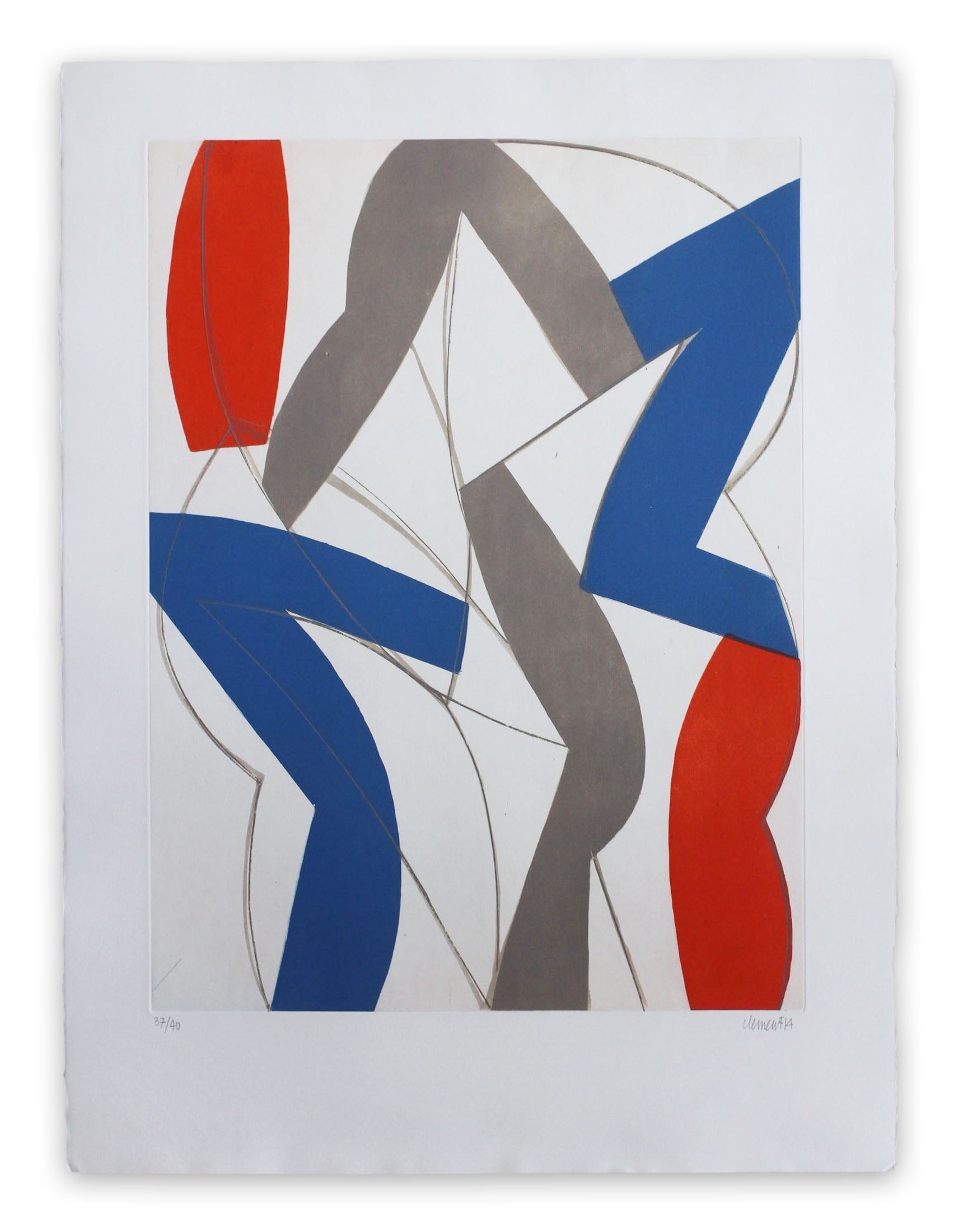
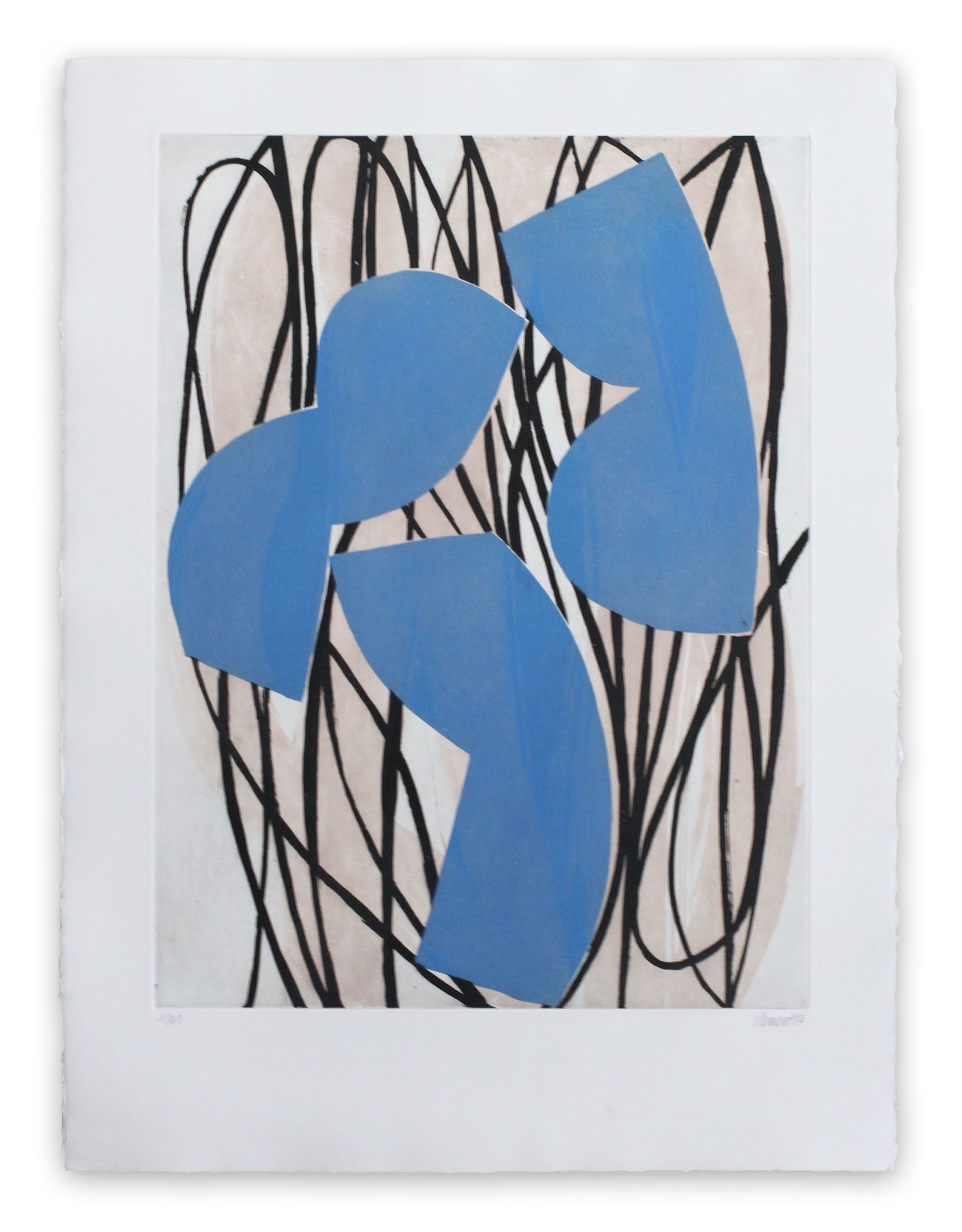
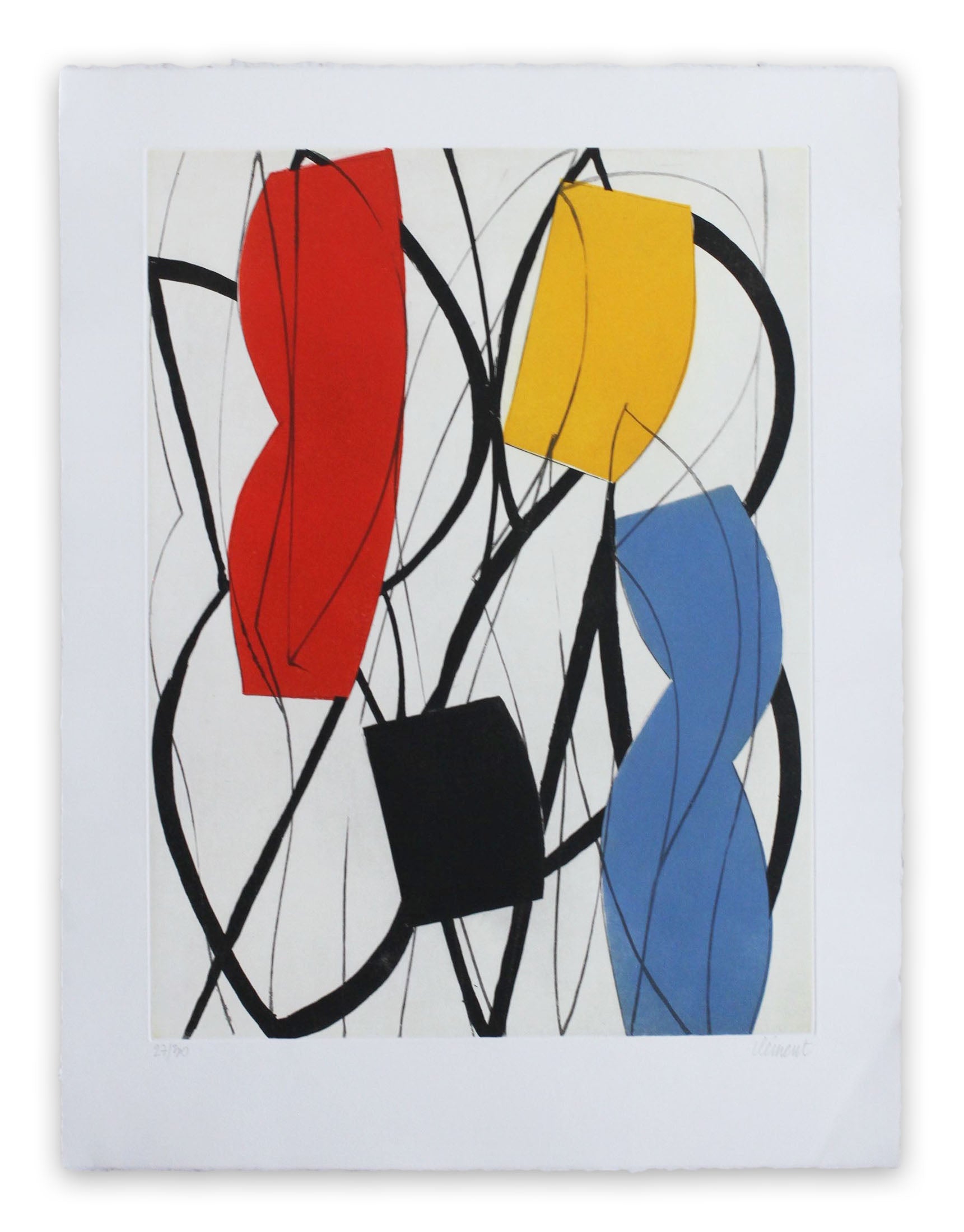
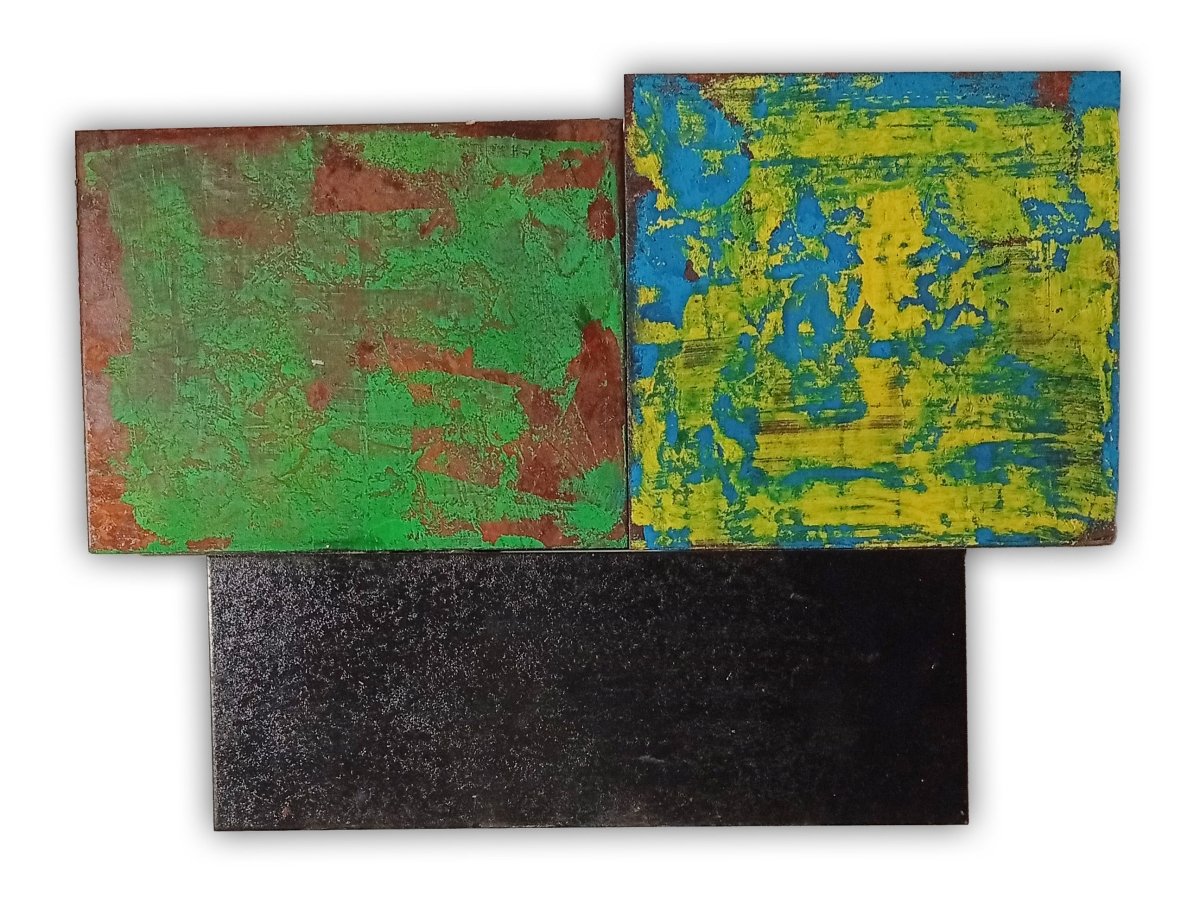
IdeelArt follows this lineage closely. Several of the artists we present are linked personally to Claude Viallat and to the Supports/Surfaces circle. Frédéric Prat, Guillaume Moschini and Jean-Daniel Salvat were his students, and each has taken the movement’s legacy in a direction of his own. André Debono, who lives a few streets from Viallat in Nîmes, is a committed materialist painter whose work stays very close to the concepts of Supports/Surfaces. Alain Clément, another major French artist, exhibited alongside Viallat as early as 1967 and worked alongside him at the École des Beaux-Arts de Nîmes. He also belongs to Viallat's close circle. Their work can be discovered below and in our collections.
For another perspective on abstraction associated with Nîmes, read our in-depth guide to Alain Clément.