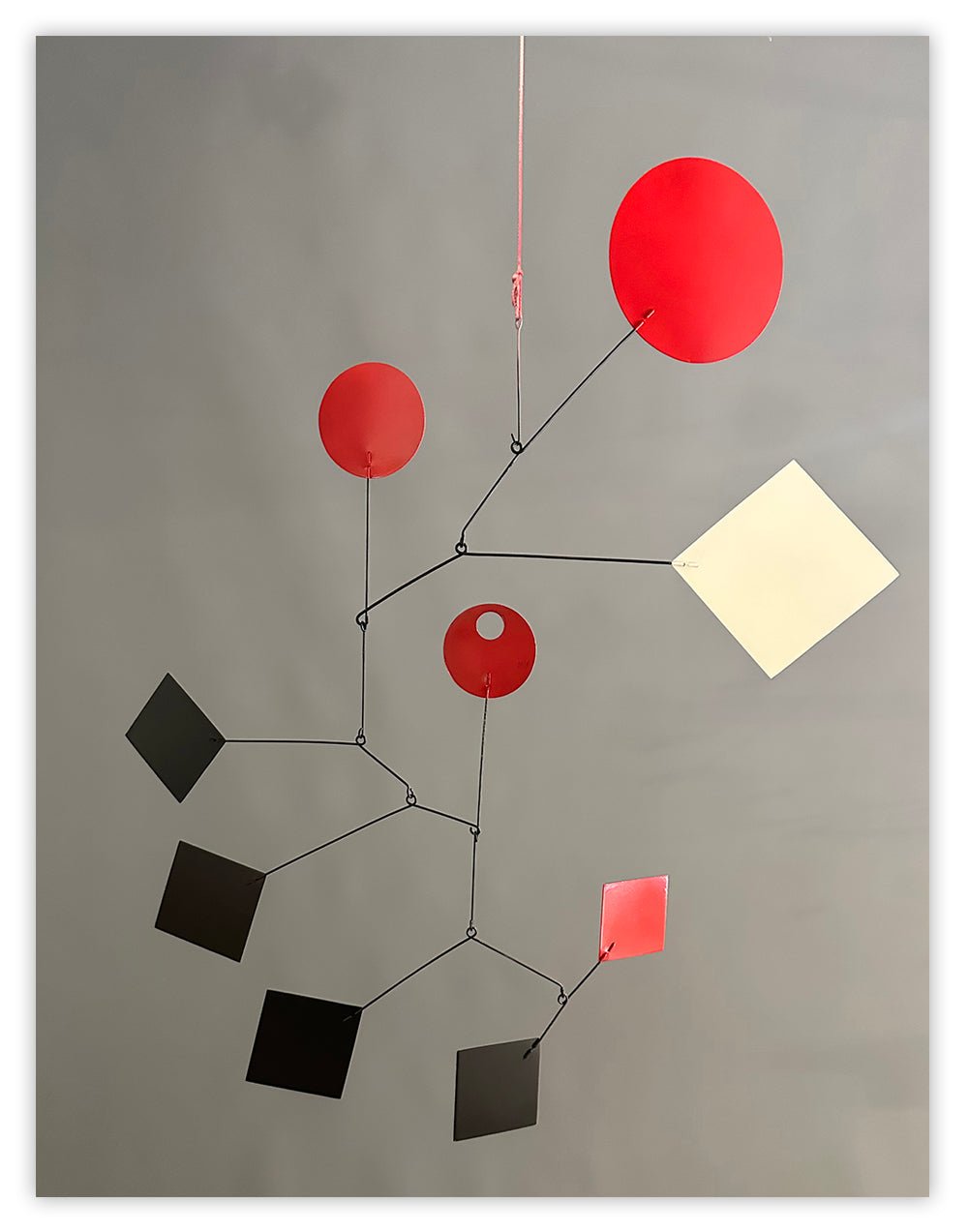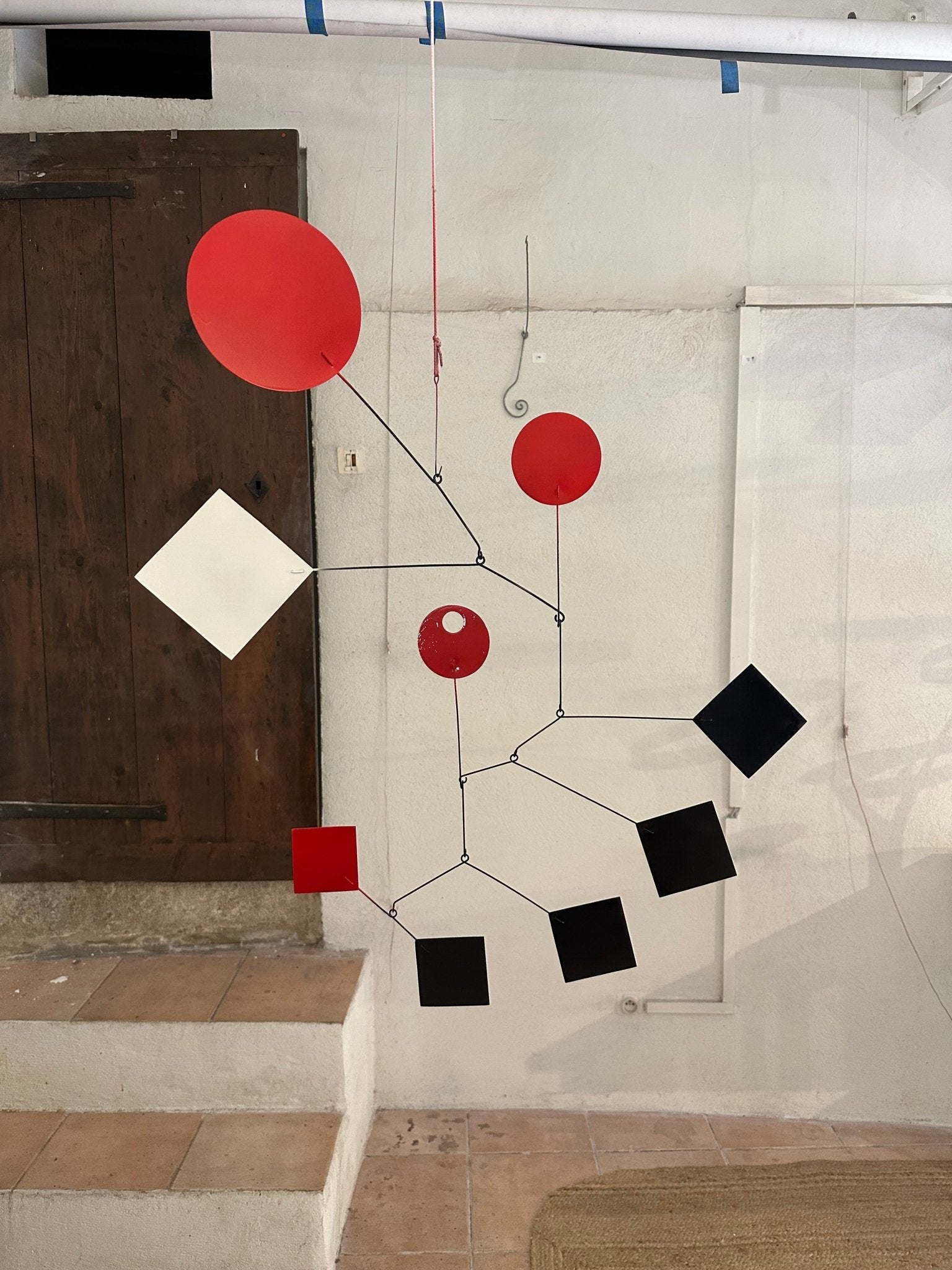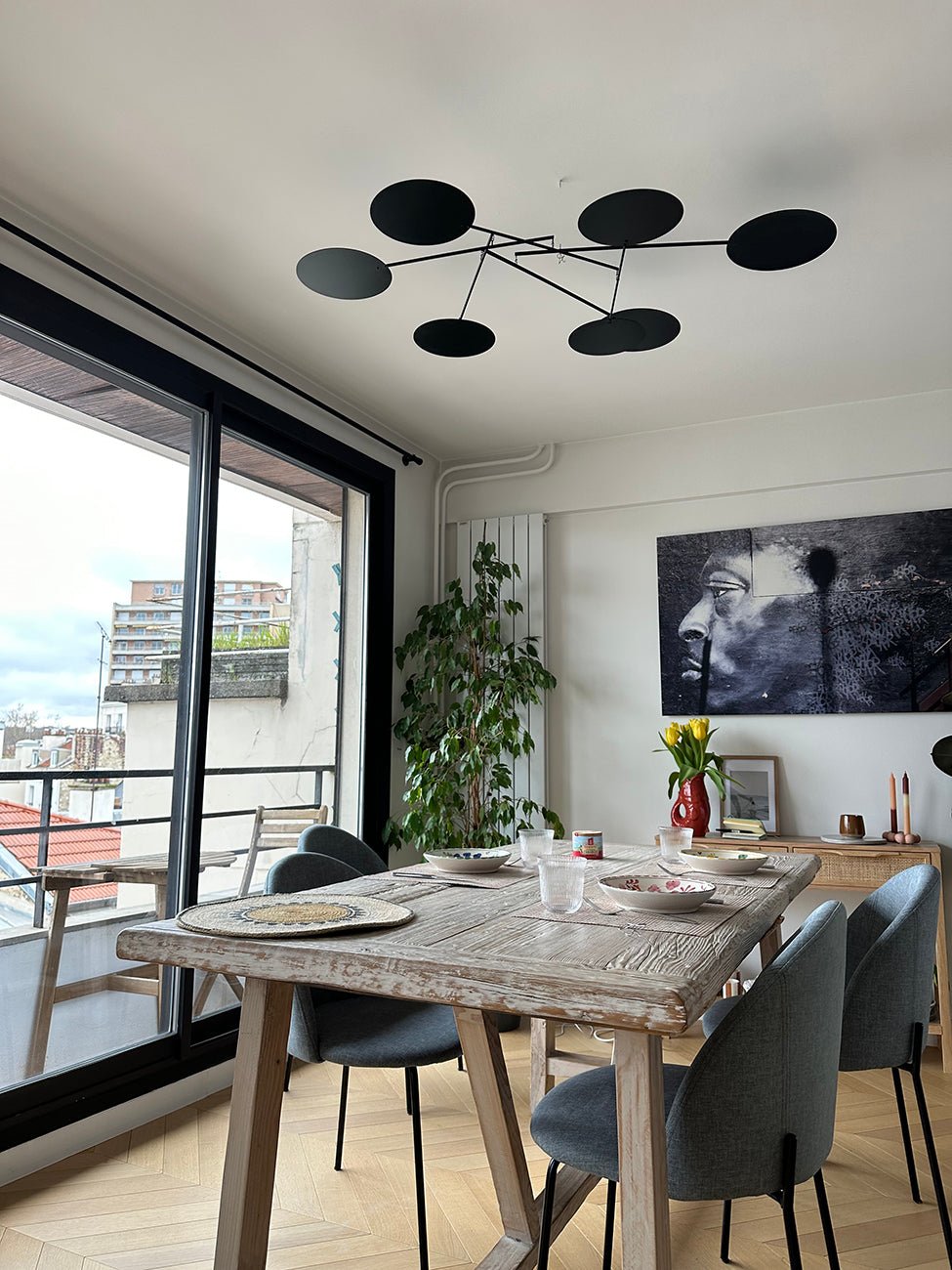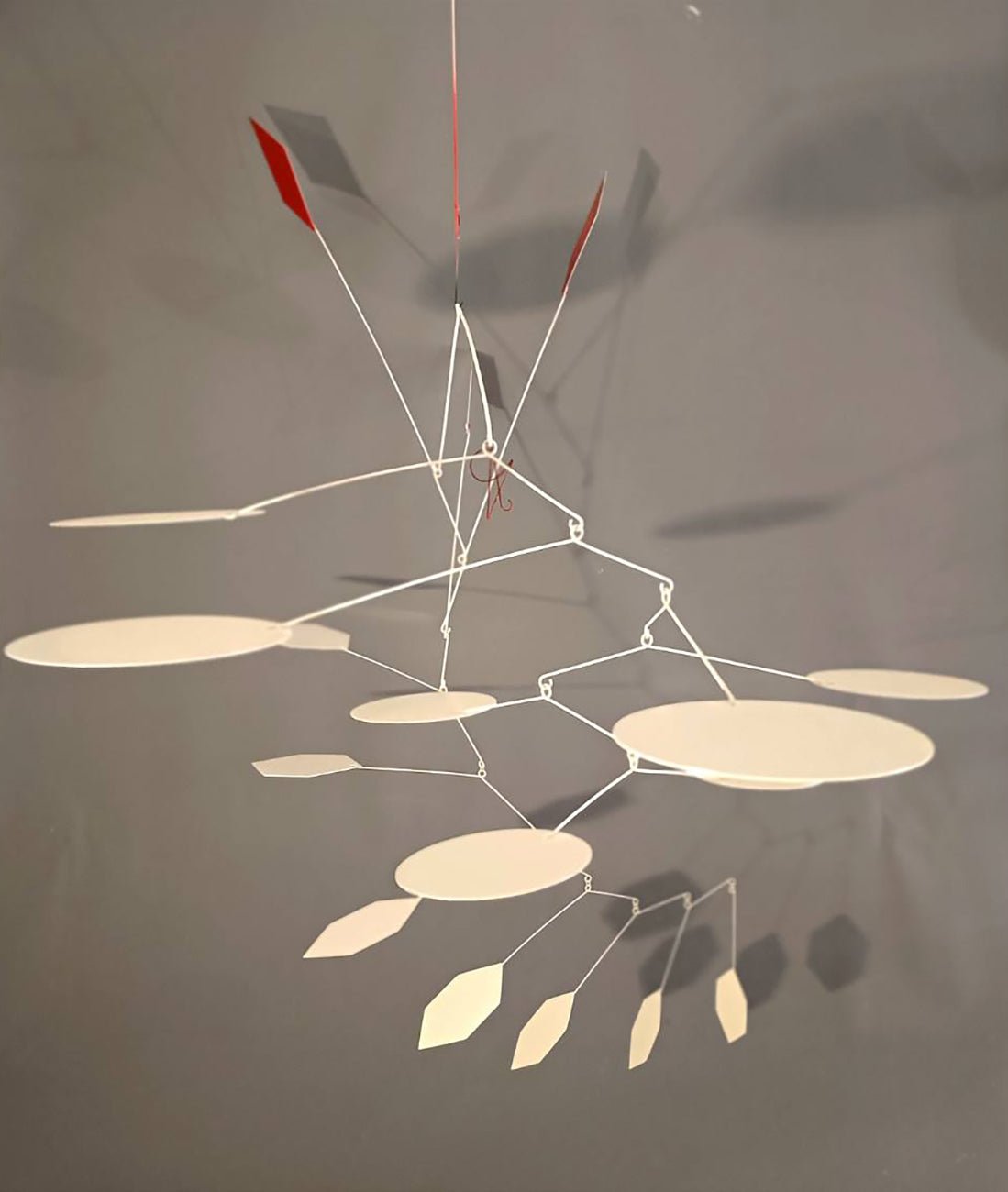

Alexander Calder: The Ultimate Guide to the Master of Kinetic Art, Wire Drawing, and Sculpted Motion
Editorial Note: On the Trail of the Master of Suspended Air
"Walking through the halls of the landmark Alexander Calder retrospective in Paris, surrounded by the delicate hum of hanging sheet-metal leaves, the shadowplay of suspended wire, and the legendary remnants of Cirque Calder, one is reminded that Calder did not simply create objects; he set space into motion. This Ultimate Guide incorporates exclusive exhibition documentation, historical archival texts, portable sculptures, and rare kinetic footage to explore how a trained mechanical engineer forever liberated sculpture from its pedestal."
Few artists in the history of 20th-century art revolutionized the physical definition of sculpture as radically as Alexander Calder (1898–1976). Before Calder, sculpture was predominantly an art of density, mass, and static weight: stone carved, bronze cast, or wood chiseled to capture a frozen moment in time. Calder dismantled this millennium-old tradition by introducing four fundamental forces: wire, air, balance, and time.
By drawing in space with flexible steel wire, inventing the motorized and wind-driven "mobile" (a term coined by Marcel Duchamp in 1931), and constructing monumental sheet-metal "stabiles" (named by Jean Arp), Calder created a new visual language where sculpture ceased to be an object to look at and became an event to experience in real time.

Alexander Calder - Five Swords - 1976
Today, Calder stands as a towering giant of modernism whose work bridges American industrial pragmatism with Parisian avant-garde poetry. This ultimate guide explores his life, his engineering breakthroughs, his legendary Cirque Calder, his intimate jewelry, his market legacy, and his enduring influence on contemporary kinetic artists.
Alexander Calder: Fast Facts
-
Born: July 22, 1898, in Lawnton, Pennsylvania, USA
-
Died: November 11, 1976, in New York City, USA
-
Education: Stevens Institute of Technology (Mechanical Engineering degree, 1919); Art Students League of New York (1923–1925)
-
Primary Mediums: Hanging and standing mobiles, painted sheet-metal stabiles, wire figurative sculptures, gouache on paper, hand-hammered brass/silver/copper jewelry
-
Associated Movements & Circles: Abstraction-Création, Surrealism, Kinetic Art, Modernism
-
Key Avant-Garde Peers & Friends: Joan Miró, Marcel Duchamp, Jean Arp, Fernand Léger, Piet Mondrian, Yves Tanguy, Georgia O'Keeffe
-
Key Studio Locations: Paris (14 rue de la Colonie), Roxbury (Connecticut, USA), Saché (Indre-et-Loire, France)
-
Major Public Collections: Centre Pompidou (Paris), Museum of Modern Art (MoMA, New York), Whitney Museum of American Art (New York), National Gallery of Art (Washington, D.C.), Tate Modern (London), Museo Nacional Centro de Arte Reina Sofía (Madrid)
-
Key Concepts: "Drawing in Space", Kinetic Balance, Mobiles vs. Stabiles, Biomimicry of Motion, Soundscapes of Metal
The Formative Years & The Paris Crucible (1898–1930)
|
Stage |
Milestones & Breakthroughs |
Key Works & Output |
|---|---|---|
|
I. Mechanical Engineering (1919) |
Earns degree at Stevens Institute of Technology; masters physics, leverage, center-of-mass balance, and metal fabrication. |
Foundational technical & structural understanding |
|
II. Art Students League (1923–1925) |
Studies illustration in NYC; captures circus performers in motion for the National Police Gazette. |
Rapid fluid line drawings, Circus Scene (1925) |
|
III. Paris Avant-Garde (1926–1929) |
Moves to 14 rue de la Colonie; replaces clay and marble with pliable wire and pliers to "draw in space." |
Wire portraits (Fernand Léger, Kiki de Montparnasse) |
|
IV. The Kinetic Universe (1926–1931) |
Builds miniature circus universe with cork, wire, and cloth; performs live studio shows for Paris elite. |
Cirque Calder (5 suitcases of articulated performers) |
From Engineering Mechanics to Drawing in Space
Born into a family of distinguished classical sculptors - his grandfather Alexander Milne Calder carved the colossal statue of William Penn atop Philadelphia City Hall, and his father Alexander Stirling Calder was a prominent Beaux-Arts sculptor - young "Sandy" Calder initially resisted the family profession. Seeking a practical career, he earned a degree in Mechanical Engineering from the Stevens Institute of Technology in 1919.
This rigorous engineering foundation in kinematics, thermodynamics, center-of-mass equations, and metallurgy proved to be his greatest artistic weapon. Calder understood the physical mechanics of equilibrium not as abstract formulas, but as intuitive physical realities.
After working briefly as a hydraulic engineer, mechanic, and draftsman, Calder enrolled at the Art Students League in New York in 1923. Working as an illustrator for the National Police Gazette, he was dispatched in 1925 to sketch the Ringling Bros. and Barnum & Bailey Circus. Captivated by the athletic trajectory of trapeze artists, lion tamers, and tightrope walkers, he developed a rapid graphic technique capable of capturing movement in a single fluid line.

Alexander Calder, 'Fernand Léger', 1930 - Wire sculpture capturing the French painter in three-dimensional contours
In 1926, drawn by the magnet of European avant-garde art, Calder moved to Paris, establishing his studio in Montparnasse. Bypassing traditional modeling clay and marble, he picked up pliable industrial wire, pliers, and wire-cutters. With these humble tools, he began "drawing in space", creating three-dimensional portraits of friends like Fernand Léger, Joan Miró, and Kiki de Montparnasse, as well as wire animals such as Medusa (c. 1930) and Shark Sucker (1930).
The Phenomenon of Cirque Calder (1926–1931)
Between 1926 and 1931, Calder created his most celebrated early masterpiece: Cirque Calder (Calder's Circus). Packed neatly into five custom wooden suitcases, this miniature, hand-operated circus universe consisted of dozens of wire, fabric, leather, cork, and yarn performers:
-
Mr. Loyat the Ringmaster blowing his whistle
-
The Lion Tamer commanding a roaring wire lion inside a collapsible cage
-
Fanni, the Belly Dancer, gyrating her hips to oriental rhythms
-
Three Tightrope Artists executing gravity-defying leaps
-
The Flying Trapeze performers soaring across miniature big-top arenas

Calder performed these circus shows by hand on the floor of his studio at 14 rue de la Colonie in Paris, sitting on a low stool while playing 78 RPM gramophone records to provide background sound effects. The Parisian elite, including Le Corbusier, Piet Mondrian, Marcel Duchamp, Joan Miró, Fernand Léger, and Jean Cocteau, flocked to his studio, mesmerized by the magical fusion of theatrical play, mechanical ingeniousness, and kinetic humor.

Calder Circus' invitation and related objects - 1929
The Great Pivot: Mondrian, Abstract Painting, and the "Mobile" (1930–1939)
The Epiphany at Piet Mondrian's Studio (October 1930)
Until late 1930, Calder's art remained primarily figurative, capturing circus performers, acrobats, animals, and portraits in wire or on paper.

Alexander Calder - The Flying Trapeze - 1925
However, in October 1930, an encounter occurred that radically transformed his career and redirected the course of 20th-century sculpture.
Calder visited the Montparnasse studio of Dutch De Stijl master Piet Mondrian at 26 rue du Départ. Mondrian's studio was not merely a workspace; it was a total immersive architectural environment. Its pristine white walls were covered with movable cardboard rectangles painted in bold primary colors (red, blue, yellow).

Alexander Calder - Untitled - 1930 - One of Calder's first pure abstract paintings
Calder recalled being utterly spellbound by the environment. Mesmerized by the floating geometric shapes, he suggested to Mondrian that it would be thrilling to make these colored rectangles oscillate and move in real space. Mondrian famously replied: "No, it is not necessary, my painting is already very fast."
The Immediate Transition: From Canvas to Moving Spatial Forms
That single afternoon acted as a revelation. Calder returned to his studio determined to realize what Mondrian resisted: abstract geometric forms physically moving in space.
To process this monumental aesthetic shock, Calder did something he had never done before: he painted pure abstract canvases for two straight weeks. Before making abstract sculptures, he turned to oil painting on canvas, experimenting with floating primary spheres, geometric discs, and stark spatial grids (Untitled, 1930, above). Painting allowed him to absorb Neoplasticism and transition mentally from figurative illustration to pure non-objective abstraction.

Alexander Calder - Object with Red Discs - 1931 - One of Calder's earliest non-objective spatial investigations following his visit to Mondrian
Within weeks, Calder took those flat abstract painted shapes off the canvas wall and suspended them in three dimensions, creating his first non-objective abstract spatial compositions: Object with Red Discs (1931) and Object with Red Ball (1931). He joined the prestigious avant-garde group Abstraction-Création alongside Auguste Herbin, Jean Arp, Theo van Doesburg, and Jean Hélion, permanently cementing his role as a leader of pure abstraction.
Coining the Terms: Duchamp's "Mobile" and Arp's "Stabile"
In late 1931, Marcel Duchamp visited Calder's studio to view a new series of motorized, hand-cranked, and pulley-driven abstract sculptures. Duchamp immediately proposed a name for these moving kinetic artworks: "Mobiles", a double-entendre in French signifying both "motion" and "motive."
Shortly thereafter, in 1932, abstract sculptor Jean Arp, viewing Calder's non-motorized, stationary sculptures, playfully asked Calder: "And what do you call these non-moving ones? Stabiles?"

Alexander Calder - The Circle - 1934 - Early Standing Mobile
Calder quickly realized that motorized mobiles were limited by repetitive mechanical cycles. By 1933–1934, he abandoned hand-cranks and electric motors in favor of ambient air currents. By suspending delicate sheet-metal shapes (organically cut discs, petals, and leaves) from interconnected wire fulcrums, he allowed natural breezes, thermal air currents, and human movement to dictate the sculpture's unpredictable, ever-shifting choreography.
The Science of Balance: Engineering, Physics, and Spatial Choreography
To understand why Calder's hanging mobiles resonate so deeply with viewers, one must examine the delicate physical balance embedded within their construction. Unlike static sculpture, a hanging mobile exists in a state of continuous dynamic equilibrium.
The Principle of the Off-Center Seesaw
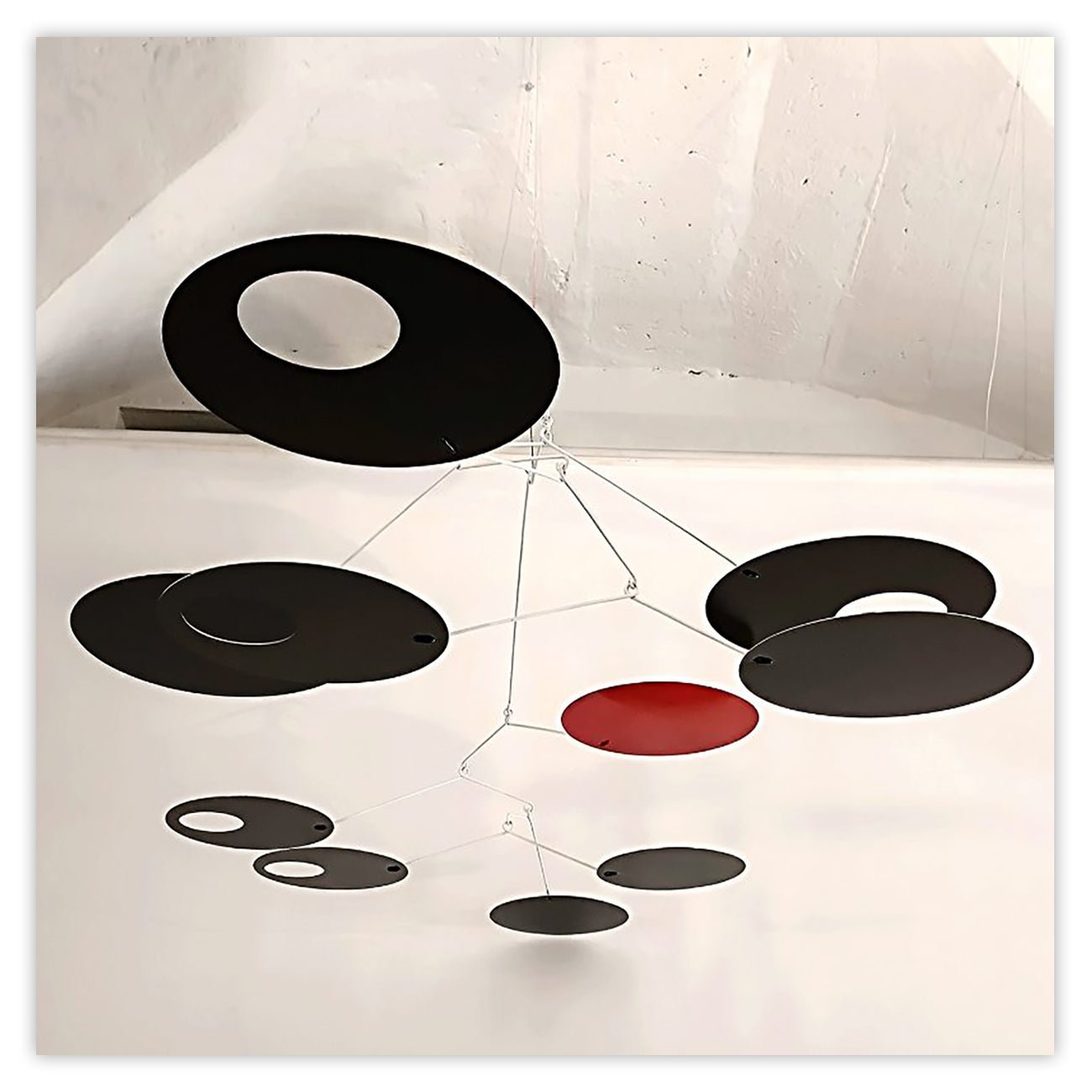
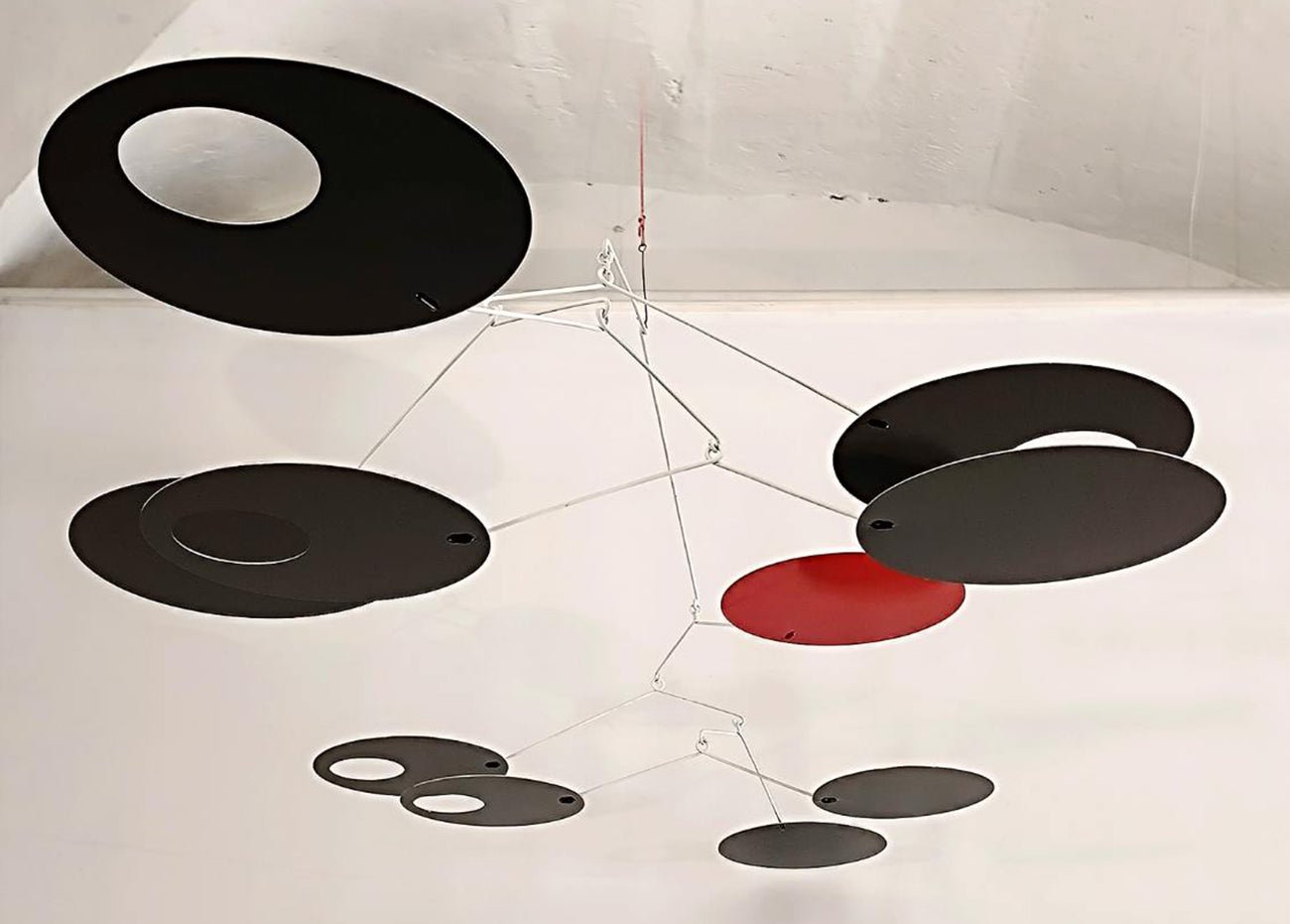
Think of every branch in a hanging mobile as an off-center seesaw. A smaller, heavier piece of metal placed close to the pivot point can perfectly balance a much larger, featherlight leaf hanging far out on a long steel wire.
Because Calder hand-hammered and trimmed every element individually without using pre-fabricated templates or written formulas, he calibrated each pivot point entirely by eye and touch. Trimming even a fraction of a gram from the edge of a red leaf alters the rotational arc and floating rhythm for the entire multi-tiered tree suspended beneath it.
Calder - Blue Panel - 1936
Shadows as Three-Dimensional Extensions
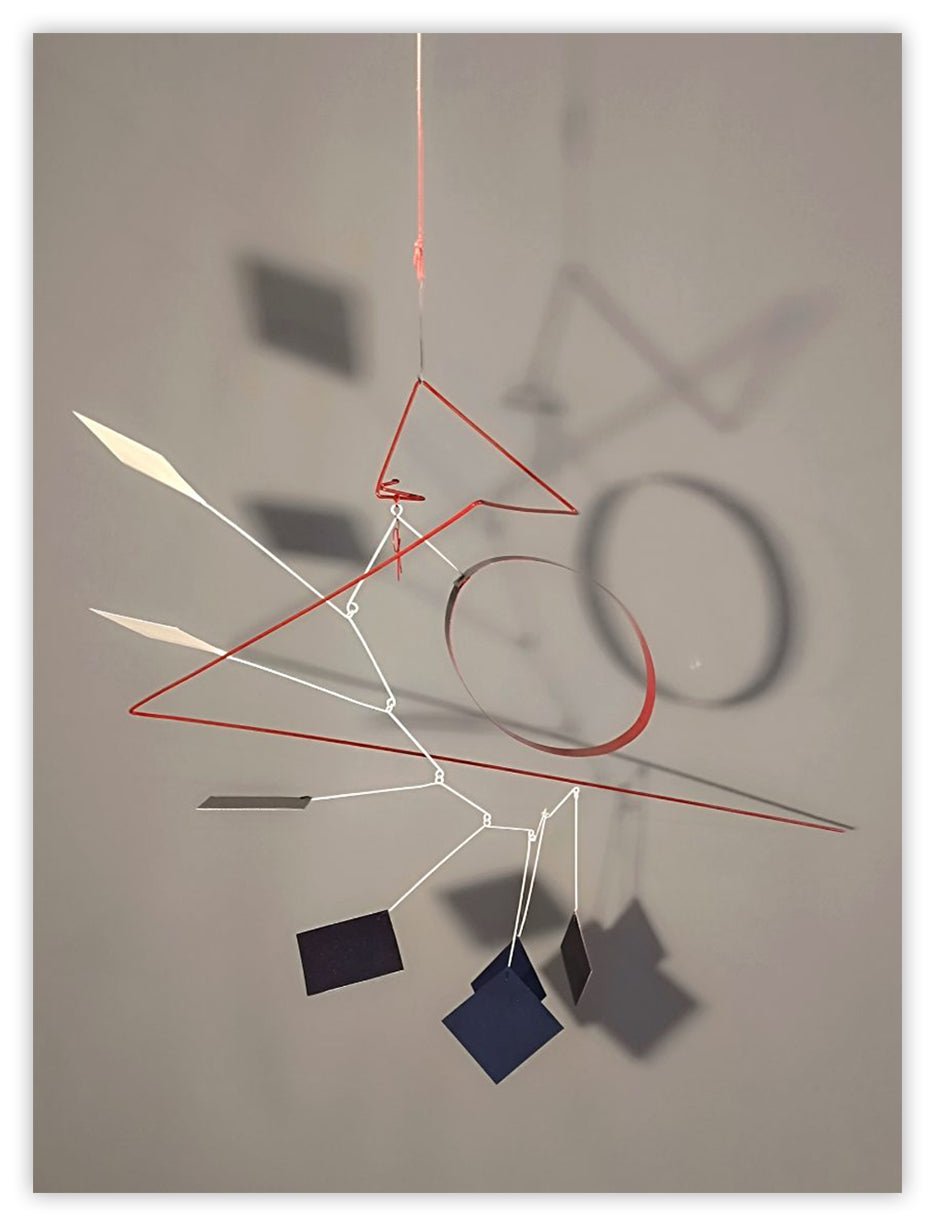
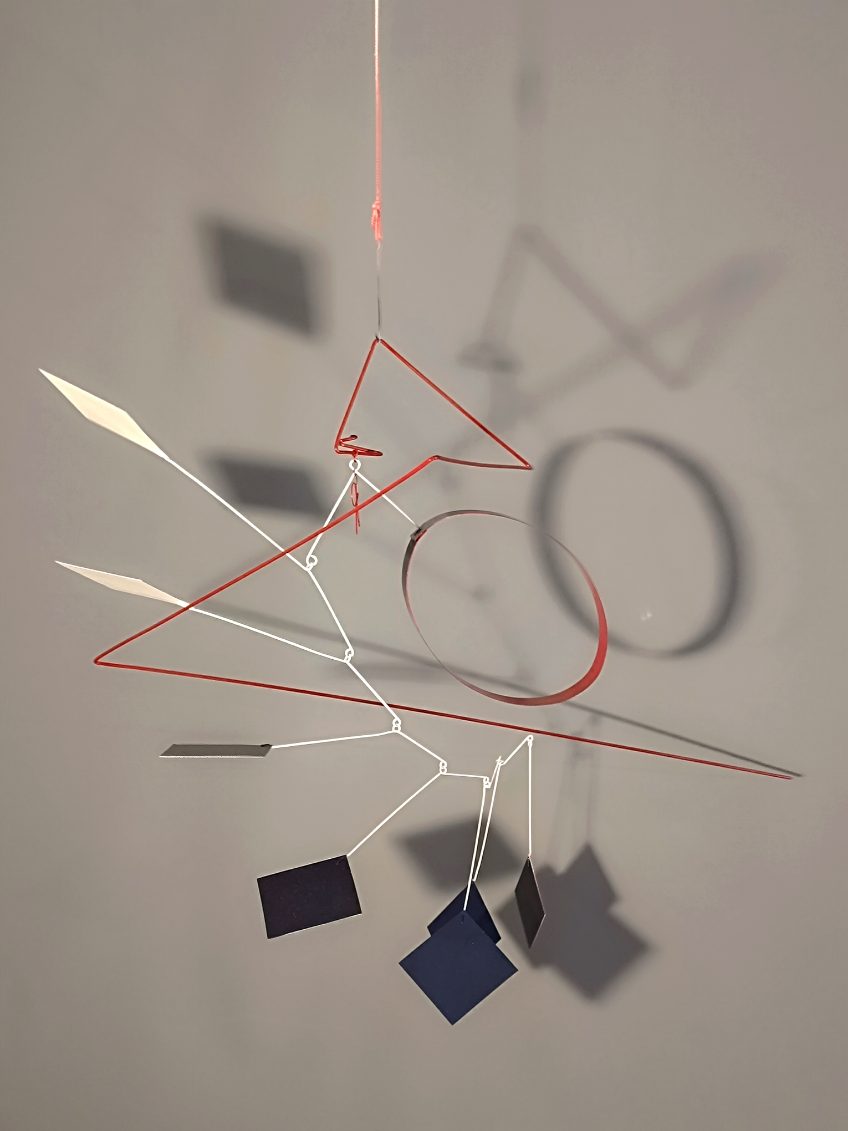
Calder viewed lighting as an integral component of his kinetic installations. As his hanging mobiles hover and drift overhead, light sources cast overlapping shadows across adjacent gallery walls and floors.
These shifting shadows create a second, "ghost" mobile, a two-dimensional projection of a three-dimensional kinetic system that transforms the static white gallery wall into a dynamic canvas.
Biomorphic Abstraction, WWII, and Post-War Masterpieces (1940–1949)
The Pre-War & Wartime Transition: Monumental Experiments & Material Shortages
As the 1930s drew to a close, Calder began experimenting with larger, grounded sheet-metal structures. A pivotal milestone of this phase was Black Beast (1940), a heavy, riveted sheet-metal stabile created on the eve of World War II that foreshadowed the aggressive architectural presence his monumental public works would achieve in later decades.

Alexander Calder - Black Beast - 1940
However, during the Second World War, industrial aluminum and sheet metal became strictly rationed for military aircraft production. Undeterred by the severe shortage of metal plates, Calder returned to his home studio in Roxbury, Connecticut, and adapted his technique.

Alexander Calder - Constellation - c. 1944 - Calder's wartime solution to metal shortages, creating cellular web-like spatial structures
Between 1942 and 1944, he carved small, organic biomorphic shapes out of carved wood (often scrap lumber or hardwood found on his property), painted them in solid primary hues, and interconnected them with stiff, unpainted steel wires. Dubbed "Constellations" by James Johnson Sweeney and Marcel Duchamp, these standing and wall-mounted structures resemble microscopic cellular organisms or cosmic planetary maps floating in weightless space.
Post-War Airborne Suspensions: Black Widow (1948) and Beyond
In the immediate post-war years, Calder returned to and dramatically expanded the physical scale of his hanging kinetic sculptures. A masterpiece of this era is Black Widow (1948), a monumental hanging mobile spanning over three meters in width. Suspended in space, its broad, sweeping black sheet-metal leaves rotate slowly above the viewer, demonstrating Calder's extraordinary ability to make massive, heavy metal shapes float with weightless grace.

Alexander Calder - Black Widow - 1948
During this period, Calder also created monumental standing mobiles and stabiles such as Laocoön (1947), combining grounded structural bases with delicate, trembling mobile crowns suspended overhead. This interplay between anchored structural mass and airborne fluidity became Calder's signature spatial dialectic.

Alexander calder - Laocoön - 1947
Portable Sculptures: Calder's Hand-Hammered Jewelry
One of the most intimate yet least commercially exposed facets of Calder's mastership is his production of hand-crafted jewelry: a body of over 1,800 unique wearable sculptures created throughout his lifetime for family, close friends, and avant-garde patrons (including Peggy Guggenheim, Georgia O'Keeffe, Joan Miró's wife Pilar, and Mary Rockefeller).

Alexander Calder - Example of wearable brass, silver, and copper sculptures/jewelry
Calder approached jewelry-making with the exact same structural mindset he applied to multi-ton outdoor stabiles:
-
Rejection of Solder: Calder almost never used heat welding or industrial solder in his jewelry. Instead, he relied exclusively on cold connections: riveting, bending, hammering, and looping wire by hand.
-
Spiral Motifs: Drawing inspiration from ancient Bronze Age artifacts, African metalwork, and Minoan jewelry, he repeatedly hammered brass, copper, and silver wire into flattening spirals, interlocking links, and energetic zig-zags.
-
Sculptural Body Armor: When worn - such as the famous brass tiara created for Peggy Guggenheim or his massive chest-covering spiral necklaces - the jewelry moves in rhythm with the wearer's body, functioning as a miniature kinetic mobile.
Monumental Public Works & Industrial Scale (1950–1976)
From the 1950s until his passing in 1976, Calder's practice expanded onto an international architectural scale. Working from his sprawling rural studio in Saché, France (along the Indre river) and collaborating with industrial iron foundries (such as Biémont in Tours), Calder erected multi-ton painted steel monuments in major cities around the globe.
| Work Title | Year | Location / Institution | Medium & Key Characteristics |
|
Mercury Fountain |
1937 |
Fundació Joan Miró, Barcelona |
Created for the Spanish Republican Pavilion at the 1937 Paris World's Fair; uses flowing liquid mercury to move a wire mobile. |
|
International Mobile |
1958 |
JFK International Airport, New York |
Monumental hanging aluminum mobile spanning over 45 feet across airport terminal space. |
|
Le Spirale |
1958 |
UNESCO Headquarters, Paris |
Monumental 30-foot standing mobile-stabile erected in the public plaza of UNESCO. |
|
Teodelapio |
1962 |
Spoleto, Italy |
Calder's first monumental steel road-spanning stabile, welded directly from heavy steel plates. |
|
La Grande Vitesse |
1969 |
Grand Rapids, Michigan, USA |
The first civic public art project funded by the National Endowment for the Arts (NEA). |
|
BMW Art Car (3.0 CSL) |
1975 |
Saché / BMW Museum, Munich |
Commissioned by Hervé Poulain; Calder transformed an endurance racing car into a high-speed painted canvas. |

Archival photograph by Jean-Marie Bottequin showing Alexander Calder in front of the BMW 3.0 CSL Art Car alongside Hervé Poulain and Jean-Louis Maeson in Saché, 1975
Amaury Maillet or The Living Lineage
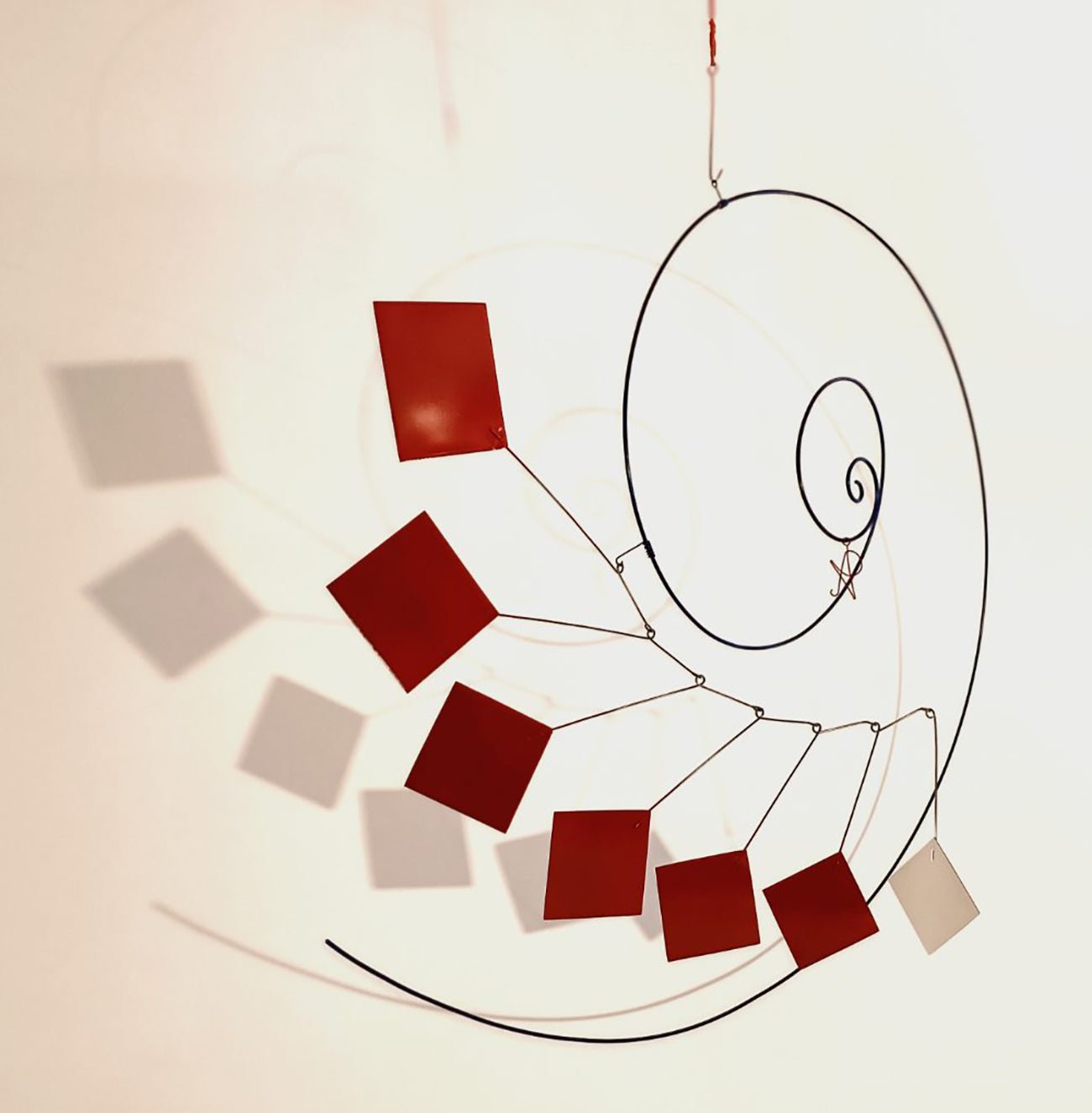
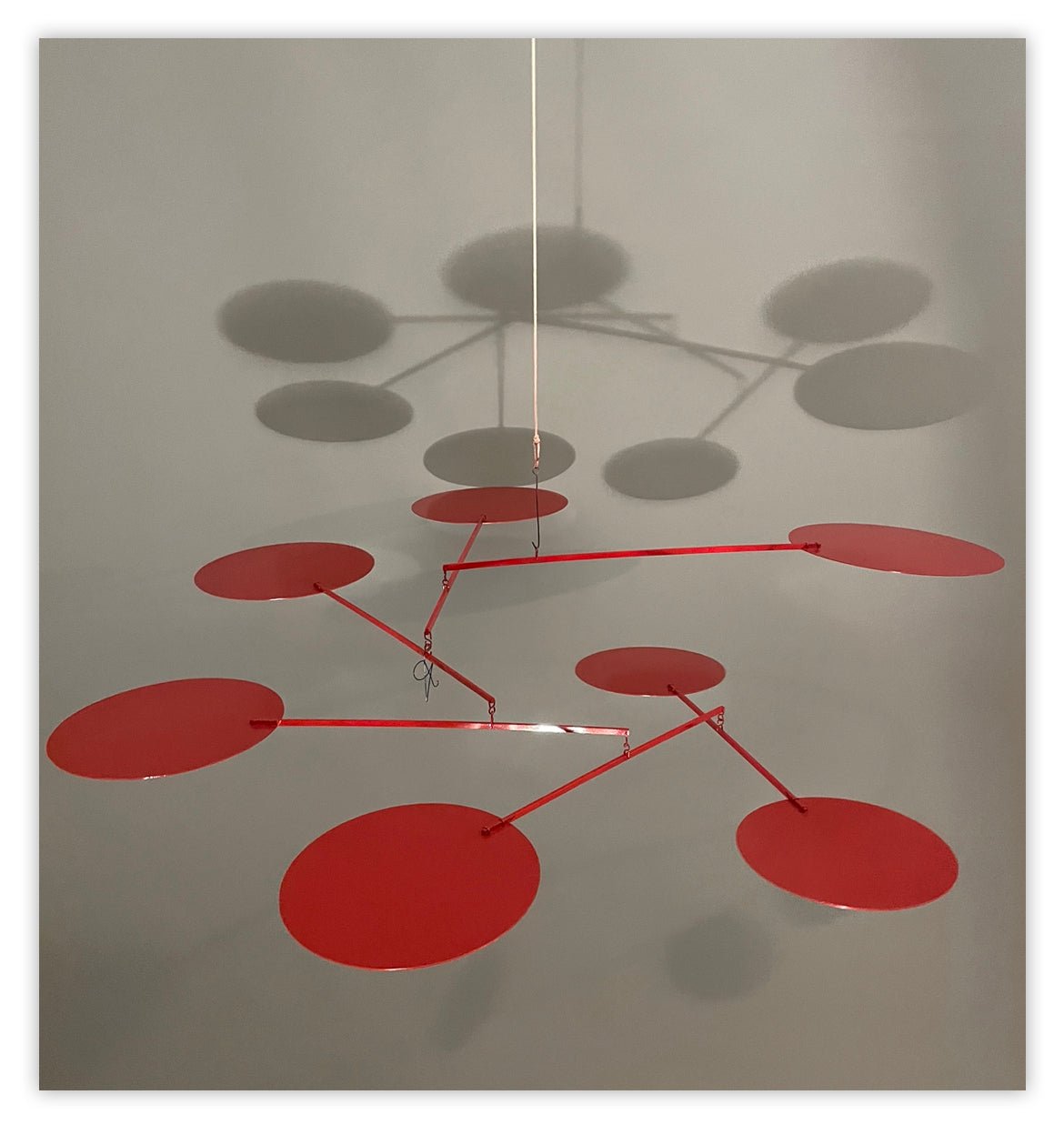
As a young artist growing up in France, Amaury Maillet had the extraordinary privilege of personally meeting Alexander Calder in the historic valley of the Indre near Saché. That firsthand encounter with Calder's workshop, where heavy steel plates, unspooled wire coils, hand tools, and floating metal disks filled the air, left an indelible mark on Maillet's artistic consciousness.

Amaury Maillet - Grand Chef - 2023
Homage and Technical Evolution
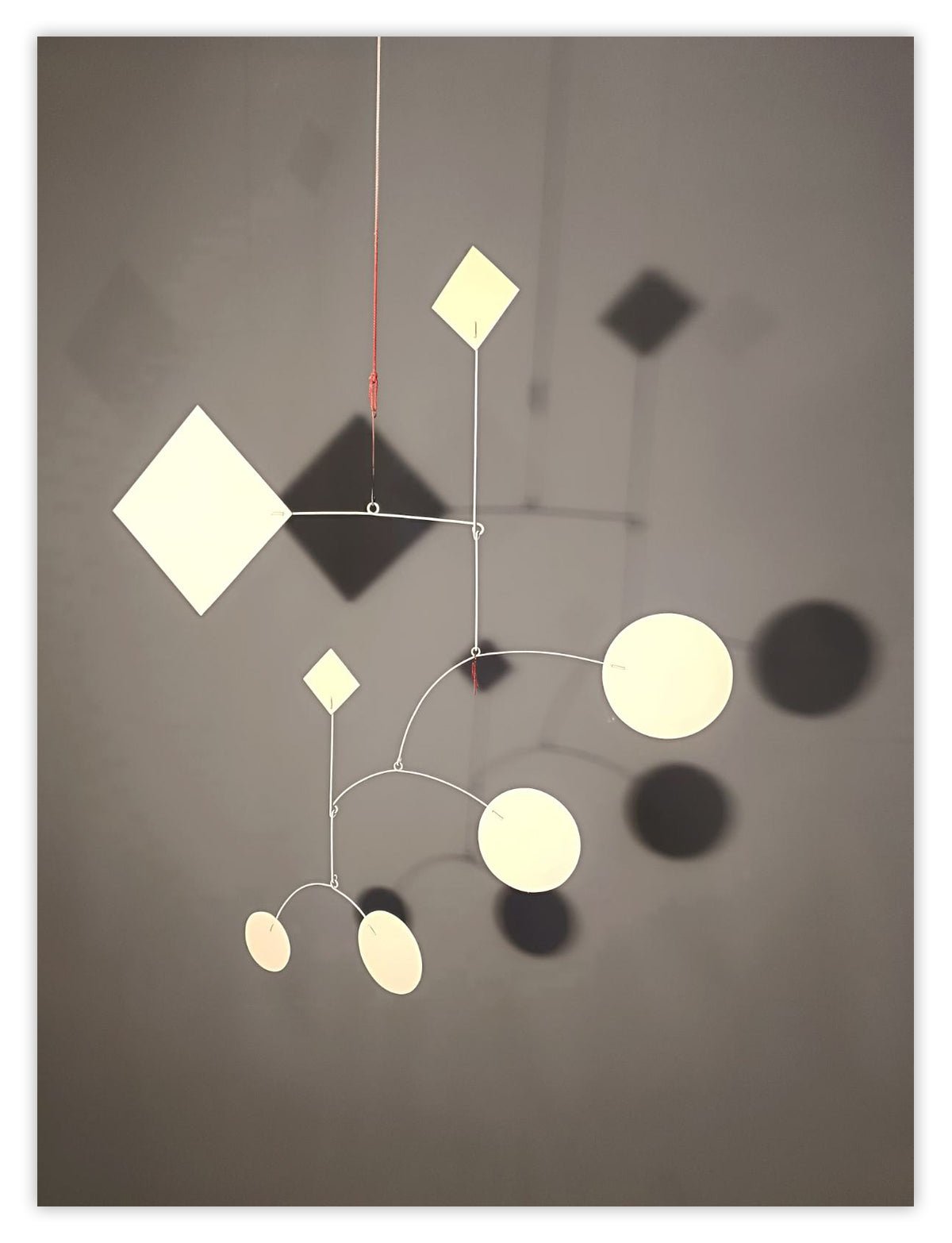
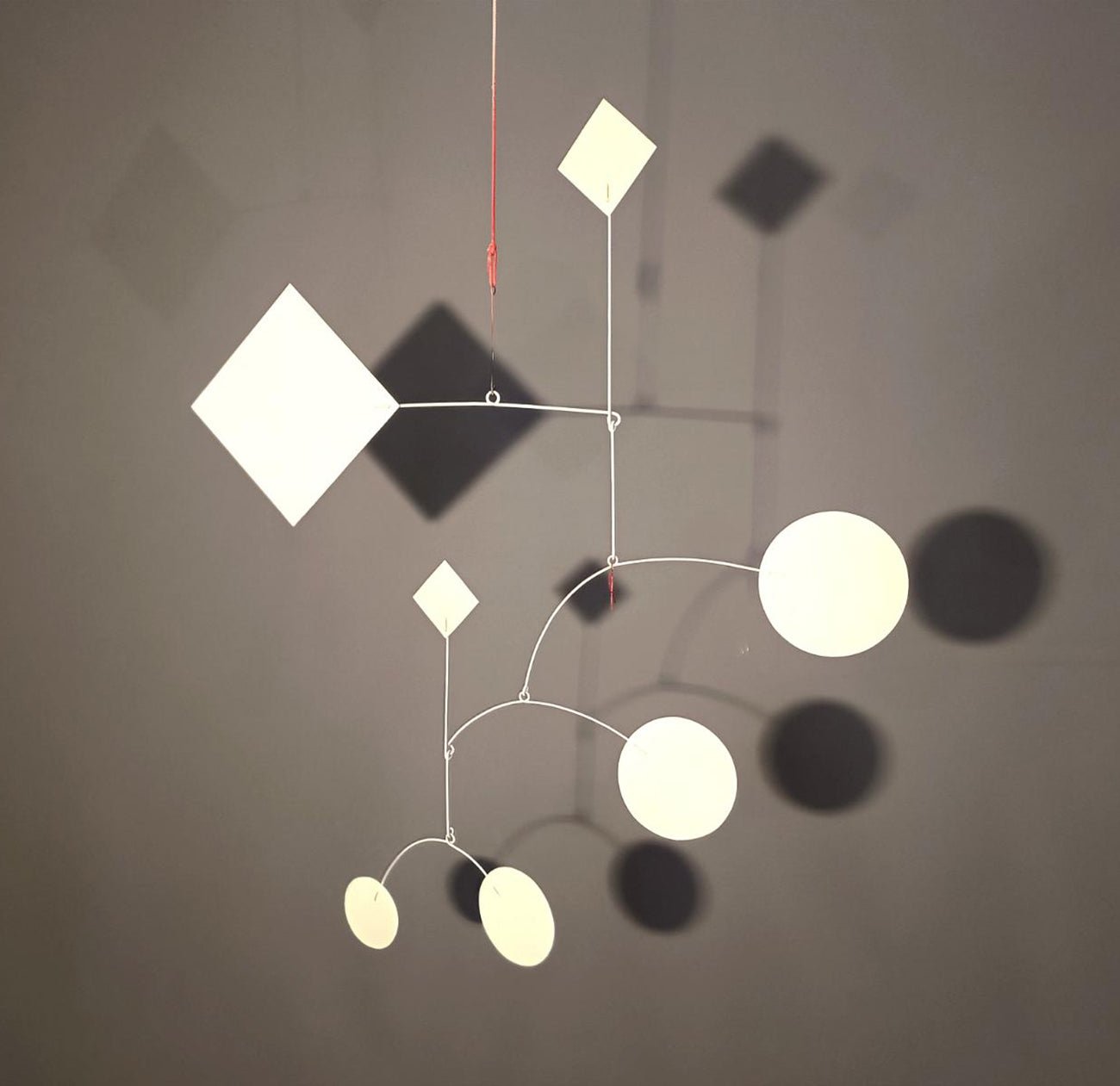
While honoring Calder's foundational breakthrough of suspended movement, Amaury Maillet has developed a distinct, modern kinetic language:
-
Refined Architectural Precision: Where Calder's mobiles celebrate the raw, industrial, hand-cut edge of sheet metal and painted iron, Maillet introduces pristine architectural geometry, razor-thin steel lines, and meticulously balanced disk elements.
-
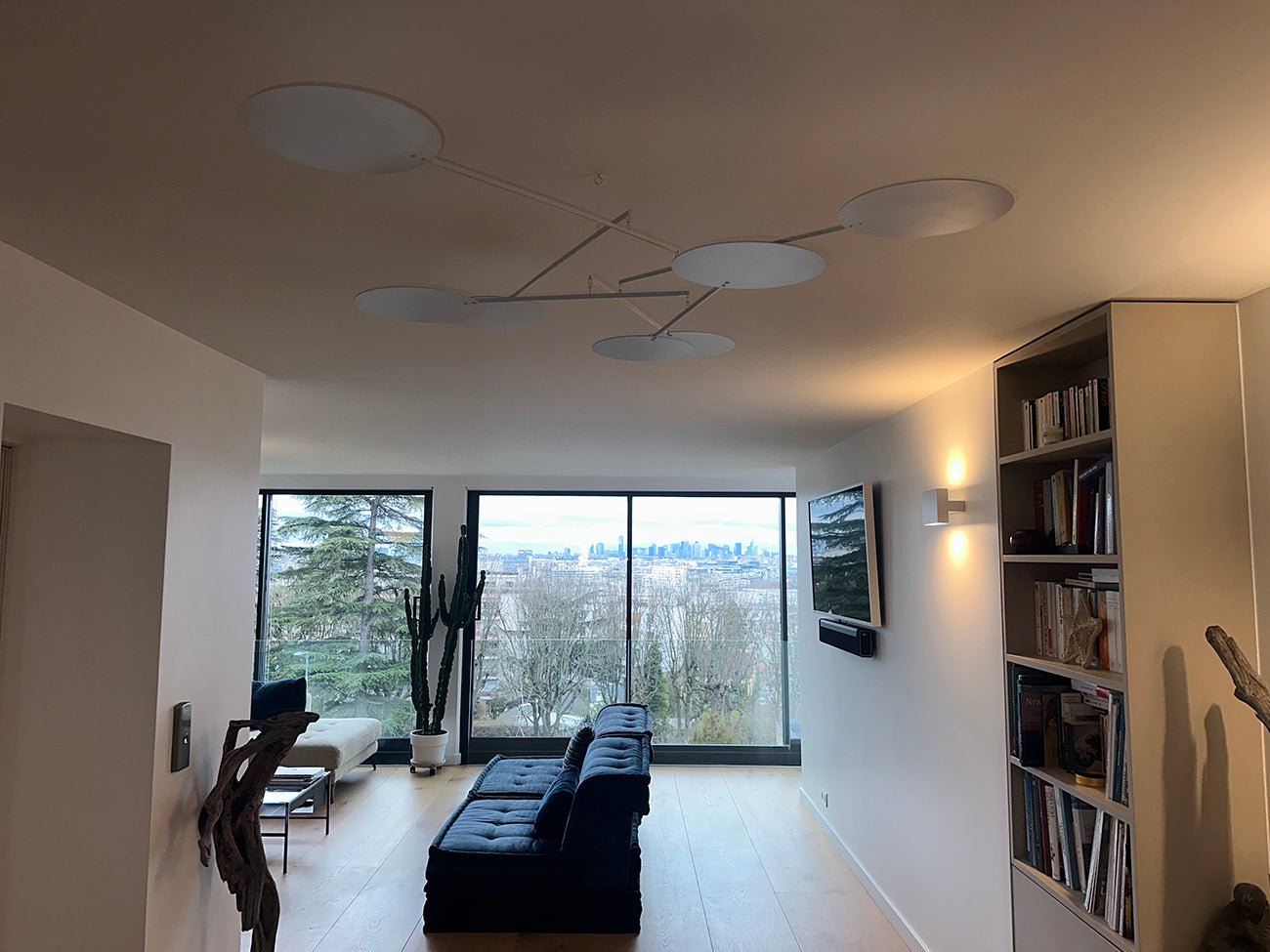
Micro-Gravitational Sensitivity: Maillet's kinetic wire sculptures respond to the subtlest atmospheric shifts in modern interior spaces: air conditioning drafts, human breath, or ambient light shifts, setting off ultra-slow, hypnotic rotations that draw the viewer into a meditative state.
-
Spatial Dialogue: Maillet continues Calder's quest to unchain sculpture from the floor, suspended between structural engineering and poetic levitation.

Amaury Maillet - White Mastodonte - 2023
Collecting Alexander Calder: Mediums, Market, and Authentication
Alexander Calder remains one of the most commercially robust and internationally sought-after blue-chip masters in auction history.
The Calder Market Spectrum
|
Category / Medium |
Price Range |
Collector Characteristics & Market Appeal |
|---|---|---|
|
Monumental Mobiles & Stabiles |
$10M – $26M+ |
Blue-Chip Masterpieces: Iconic 1940s–1950s works (e.g., Poisson volant at $25.9M). Sought by major international museums and top-tier global foundations. |
|
Standing & Table Mobiles |
$1M – $8M |
Architectural Centerpieces: Perfect scale for high-end residential interiors and private collections. Extremely high demand at Sotheby's & Christie's. |
|
Gouaches on Paper |
$50K – $300K |
Vibrant Graphical Entry: Highly recognizable studio works featuring bold suns, snakes, spirals, and primary geometric moons. |
|
Original Prints & Jewelry |
$5K – $40K |
Accessible Fine Art & Wearable Sculpture: Limited edition lithographs/screenprints and rare hand-hammered brass, copper, or silver wearable jewelry. |
Authentication & Foundation Verification
All authentic works by Alexander Calder are meticulously cataloged and registered by the Calder Foundation in New York, which assigns an official application number (A-number) to verified pieces.
Frequently Asked Questions (FAQ)
1. Who invented the term "mobile" for moving sculptures?
The term "mobile" was coined in late 1931 by legendary avant-garde artist Marcel Duchamp during a visit to Alexander Calder's Paris studio. In French, "mobile" playfully refers to both "that which moves" and "motive/impulse."
2. What is the difference between a mobile and a stabile?
A Mobile is a kinetic sculpture that features hanging or standing moving parts driven by air currents or motors. A Stabile (a term coined by artist Jean Arp in 1932) is a stationary, non-moving abstract sculpture, typically constructed from heavy, riveted sheet-metal plates anchored to the ground.
3. Did Alexander Calder have formal engineering training?
Yes. Calder earned a degree in Mechanical Engineering from the Stevens Institute of Technology in 1919. This technical education gave him a deep understanding of physics, center-of-mass balance, structural loads, and metallurgy, which he directly applied when designing his mobiles and multi-ton public stabiles.
4. What was Cirque Calder (Calder's Circus)?
Created between 1926 and 1931, Cirque Calder was a miniature, hand-operated circus constructed from wire, leather, cloth, cork, and string. Calder packed the entire circus into five wooden suitcases and performed live shows in his Paris studio, complete with gramophone sound effects. It became an avant-garde sensation attended by Miró, Duchamp, Léger, and Le Corbusier.
5. How do Calder's hanging mobiles stay balanced without motors?
Calder's hanging mobiles rely on the mathematical physics of asymmetrical levers and fulcrums. By suspending each tier of wire rods from precise counterbalancing pivot points, the weight of every metal shape is perfectly offset by the shapes on the opposite side, allowing natural air currents to set the sculpture in motion.
6. Why did Piet Mondrian inspire Calder to make abstract moving art?
When Calder visited Piet Mondrian's Paris studio in October 1930, he was mesmerized by Mondrian's wall of movable colored cardboard rectangles. Calder suggested making the shapes move in space, but Mondrian refused. Calder left determined to bring abstract geometric shapes to life through physical motion, marking his transition from figurative wire drawing to kinetic abstraction.
7. What are Calder's Constellations?
The Constellations are a series of biomorphic sculptures created between 1942 and 1944. Because metal was rationed for military use during WWII, Calder carved small wooden shapes, painted them in primary colors, and connected them with stiff steel wires, creating cell-like web structures suspended in space.
8. Did Alexander Calder make wearable jewelry?
Yes. Calder hand-crafted over 1,800 pieces of unique wearable jewelry (necklaces, tiaras, brooches, rings) made from hammered brass, silver, and copper wire. He never used industrial solder, relying exclusively on cold rivets and wire loops. Famous patrons included Peggy Guggenheim and Georgia O'Keeffe.
9. Where can you see Calder's monumental public sculptures?
Calder's public stabiles and mobiles are installed across major global locations, including UNESCO Headquarters in Paris (Le Spirale), JFK Airport in New York (International Mobile), Grand Rapids, Michigan (La Grande Vitesse), and the Fundació Joan Miró in Barcelona (Mercury Fountain).
10. How does contemporary sculptor Amaury Maillet relate to Calder?
French kinetic artist Amaury Maillet met Alexander Calder as a young artist near Calder's Saché studio in France. Maillet carries forward Calder's legacy of kinetic wire sculpture, refining it with pristine modern architectural lines, laser-cut geometry, and micro-gravitational balance.
11. What is a "standing mobile"?
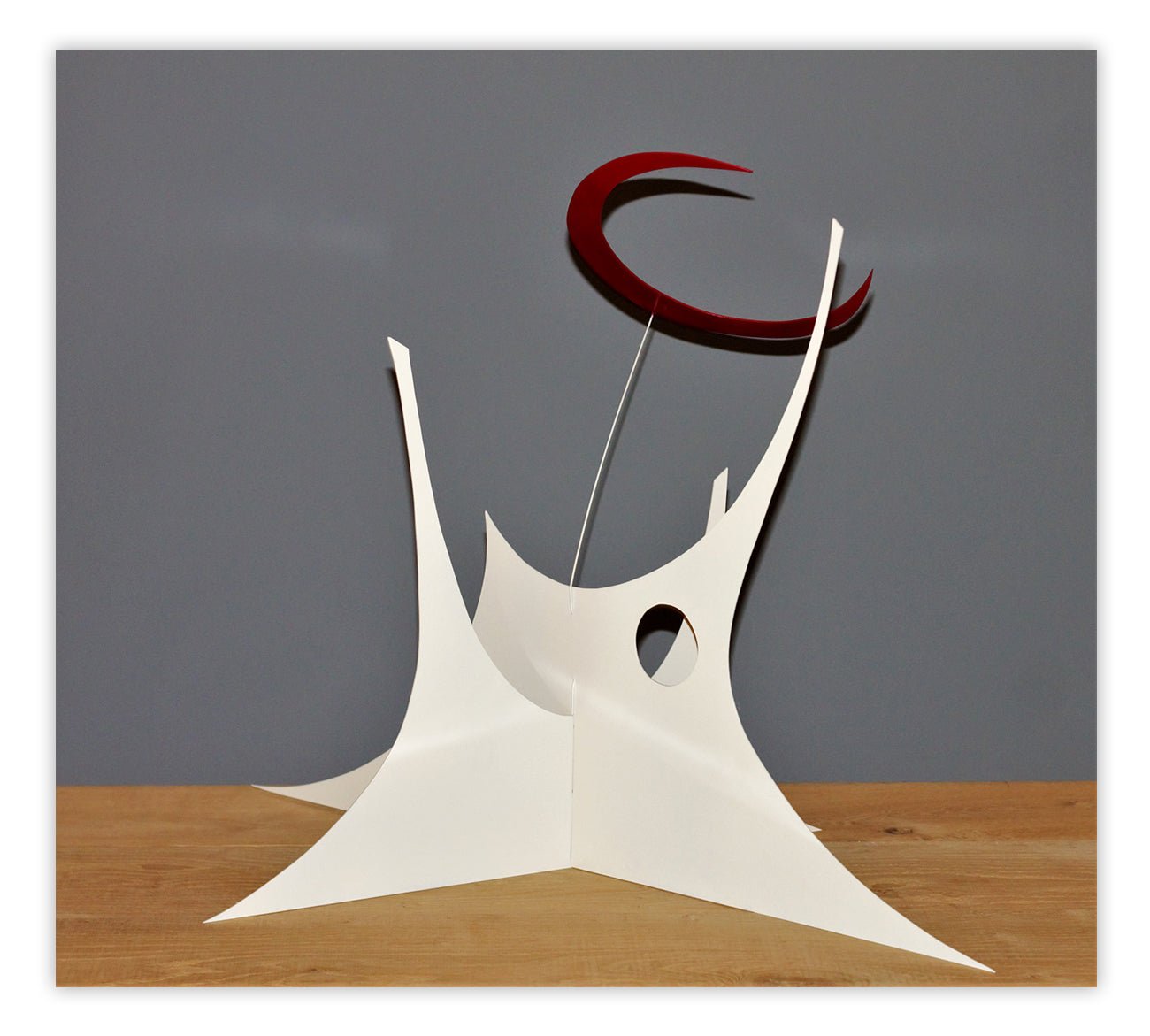
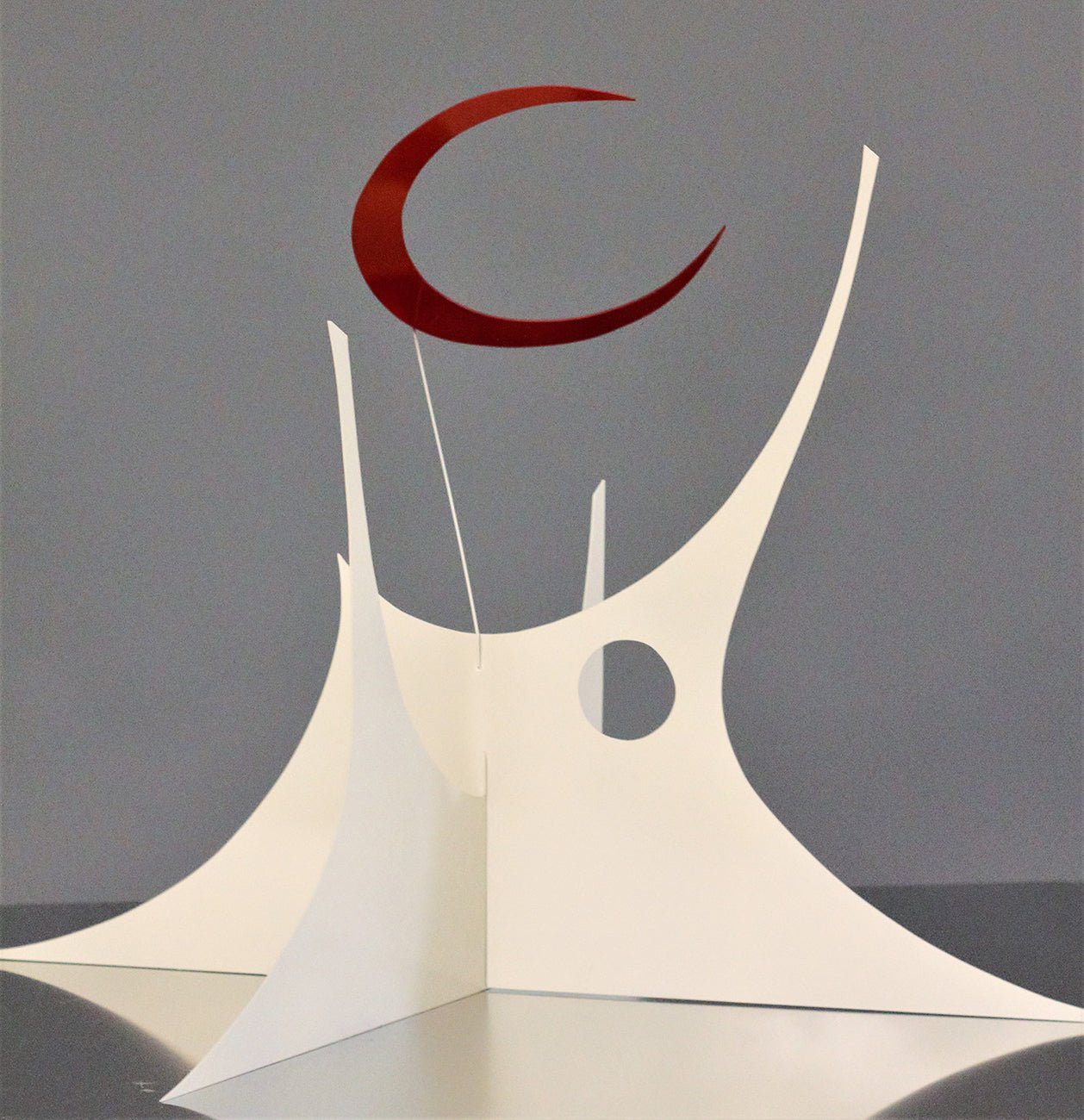
A standing mobile features a fixed, stationary sheet-metal base (a stabile base) anchored to the floor or table, from which a flexible wire fulcrum extends upward to balance a free-floating, wind-driven mobile crown.
12. What colors did Alexander Calder primarily use?
Calder restricted his palette primarily to unmixed primary colors (red, yellow, blue) alongside stark black and white. He believed primary hues created the strongest visual contrast against natural background environments and gallery walls.
13. What is the Calder Foundation?
Founded in 1987 by Calder's family, the Calder Foundation is a non-profit organization based in New York dedicated to collecting, exhibiting, preserving, and authenticating the artwork and archival records of Alexander Calder.
14. Did Calder paint cars?
Yes. In 1975, collector and racing driver Hervé Poulain commissioned Calder to paint a BMW 3.0 CSL endurance racing car. This became the very first official "BMW Art Car," debuting at the 24 Hours of Le Mans.
15. How should collectors care for a hanging Calder mobile or kinetic wire sculpture?
- Air Circulation: Hang kinetic sculptures away from direct, high-velocity heating or cooling vents to prevent violent collision between wire arms.
- Handling: Always hold mobiles by the primary top suspension hook or base, never by the delicate side wire arms or painted leaves.
- Dusting: Clean with soft, dry goat-hair brushes or microfiber dusters; avoid chemical liquid cleaners that could strip original matte gouache paint.
Photo Gallery